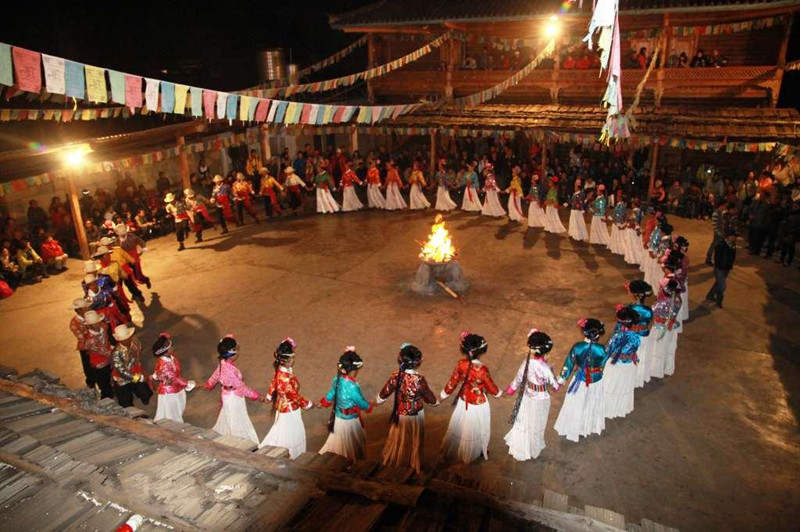
The Bonfire Party is a traditional social event for the Mosuo (摩梭) people, where young men and women express their affection and seek partners. It is an integral part of the Mosuo walking marriage (走婚) customs. During the party, Mosuo women dress in elaborate attire and participate in fire dances, while men express their feelings through dance invitations or by gently pressing palms. If a woman reciprocates, she reveals the location of her "flower house" (花楼). The man must then overcome a series of challenges after midnight—climbing walls, calming guard dogs, and cutting through door bolts—before he is allowed to enter. This ritual reflects the matrilineal society of the Mosuo people, where men do not marry and women do not wed.
Event Overview
Traditional Marriage Customs
Main Activities: Bonfire dance, affection expressed through palm pressing.
Walking Marriage Rituals: Climbing walls, calming dogs, cutting door bolts.
Sword Carrying Tradition: Men carry a waist knife after their coming-of-age ceremony, a tool used in the walking marriage custom.
Event Process
Preparation: Before the bonfire party starts, Mosuo youth dress carefully—women wear silver jewelry and headscarves, while men carry waist knives.
Group Dance: The evening begins with a collective dance where men and women exchange glances and gestures to show mutual affection.
Palm Pressing: Interested men press the woman's palm three times during the dance. If the woman responds similarly, it indicates she accepts his affection.
Flower House Location: If a woman is interested, she subtly reveals the location of her flower house (花楼).
Challenges: After midnight, the man must face three obstacles to reach the woman’s flower house:
Climbing the Wall: Testing his physical strength.
Calming the Guard Dogs: Testing his patience.
Cutting the Door Bolts: Proving his determination.
Sword Carrying Custom
Following Mosuo tradition, men are allowed to carry a waist knife after their coming-of-age ceremony at the age of 13. This knife is used to cut the door bolts of a woman’s flower house during the walking marriage ritual. The knife symbolizes adulthood and must be carried for life. It is an essential tool in the walking marriage tradition.
Mosuo Folk Museum in Lijiang
Cultural Experience Highlights
Jia Cuo Dance (甲搓舞)
This national intangible cultural heritage dance is characterized by strong, bold movements. Participants link arms and dance counterclockwise around a bonfire, led by a flute player. The dance’s various songs have different meanings, including blessings, harvest celebrations, and expressions of love.
Walking Marriage Culture Display
The performance includes love song duets, explanations of walking marriage customs, and unique Mosuo scenes such as Mosuo girls throwing flower belts and young men climbing flower houses.
Bonfire Carnival
Every evening at 8:00 PM, Mosuo youth, dressed in traditional attire, invite visitors to join them around the bonfire for a lively, hour-long dance.
Practical Information
Ticket Prices:
Daluoshui Village (大落水村): 30 RMB per person
Dazu Village (达祖村): 50 RMB per person
Discounts may be available through private tour guides.
Recommended Locations:
Daluoshui Village Bonfire Party (大落水村锅庄篝火晚会)
Dazu Village Bonfire Performance Center (达祖村篝火晚会演艺中心)
Special Timing:
Special events are held during the Fire Torch Festival (火把节) in July.
In the peak months of July and August, it is recommended to secure a spot early.
Activity Flow:
Ethnic Song and Dance: Performances by Mosuo singers and dancers, accompanied by the "Bawu" flute.
Interactive Segment: Visitors can join the Jia Cuo dance, experiencing Mosuo social customs.
Bonfire Dancing: The entire audience dances around the bonfire, creating a lively atmosphere.
Tips:
Some venues offer paid photo services (around 20 RMB per photo).
Visitors can combine their bonfire party experience with a pig-trough boat (猪槽船) ride or walking marriage banquet (走婚宴).
Cultural Background
The bonfire party serves as a living representation of the Mosuo matrilineal clan culture, using collective dances to foster group identity. The fire symbolizes the continuity of life, while the male-female duets subtly express the walking marriage culture.
mosuo-ethnic-people-in-lugu-lake-lijiang-07
Lugu Lake Bonfire Party: Surprises and Disappointments
While Lugu Lake (泸沽湖) is breathtakingly beautiful, the traditional Mosuo Bonfire Party might not meet all expectations. Here's a detailed review:
? Seating: The venue allows for flexible seating. At 7:30 PM, there aren't many people, so you can easily find a spot.
? Dance Performances: Local women perform dances as they enter. While they don’t put in much energy, their movements are synchronized. The male dancer leading the performance stands out, showcasing the charm of Mosuo dance.
? Program Content: The program is relatively simple, mostly consisting of dance performances, which can feel a bit monotonous without other diverse acts.
? Interactive Segment: After the dance, visitors are invited to participate. However, the experience can become chaotic in crowded areas, affecting the quality of interaction.
Overall, while the Mosuo traditional bonfire party lacks some polish, the dance performances and interactive segments still offer an authentic and enjoyable experience.
What Makes It Special
Attraction Highlights
CULTURE
Mosuo Matrilineal Culture
The Mosuo are a distinct ethnic group near Lugu Lake, noted in ethnographic literature for matrilineal households and the tisese partnership system; their evening gatherings reflect this community-centered social life.
DANCE
Circle Dances Around the Fire
Bonfire parties feature Mosuo folk songs and group dances performed in traditional clothing; the event is a social occasion for villagers and a cultural introduction for visitors.
EXPERIENCE
Join the Bonfire Celebration
Evening programs typically combine a lit bonfire, Mosuo folk music, group dancing and photo opportunities; the format is informal and encourages audience participation rather than passive viewing.
NATURE
Plateau Lake Setting
Lugu Lake lies about 2,685 meters above sea level on the Yunnan-Sichuan border; its clear water, wooded hills and five islands form the backdrop for lakeside evening events.
SEASON
Best Visits in Spring and Autumn
Spring and autumn usually bring milder temperatures and clearer views around Lugu Lake; summer coincides with the rainy season, while winter nights can be cold for outdoor bonfire programs.
Internal Transport
Walking lanes in the village
The bonfire party is held in an open plaza or courtyard in Luoshui or Lige village; access is on foot through village lanes, usually a 5–15 minute walk from nearby guesthouses.
No dedicated shuttle, cable car, or sightseeing cart
There is no internal shuttle bus, cable car, or sightseeing cart serving the bonfire party itself; visitors arrange their own transport to the village.
Vehicle drop-off at village entrance
Taxis and tour vehicles stop at the village entrance or main roadside; from there, follow signs or ask locally for the short walk to the bonfire ground.
Lugu Lake loop road connections
Local buses and tour vehicles use the lakeside road to connect Luoshui, Lige, and Daluoshui during the day; use these for transfers between villages before the evening event.
Tips: There is no internal shuttle for the bonfire party, so arrange a taxi or walk from your guesthouse in Luoshui or Lige and confirm the start time and meeting point with your hotel. The event is in the evening, so plan your return transport in advance.
Lijiang, one of China's most popular destinations and home to an amazing array of sights, activities and events. Jade Dragon Snow Mountain is the southernmost glacier in the Northe...
Lijiang - Jade Dragon Snow Mountain - Baoshan Stone Town - Wumu Village of Baoshan Town in Yulong County, Lijiang - Lijiang
3 Days1 Places
You'll trek through mountainous terrain, visit ancient villages perched above river valleys, and immerse yourself in the breathtaking beauty of the region. Along the way, you'll ex...
Lijiang - Tiger Leaping Gorge - Yuhu Village - Baisha Ancient Town - Lijiang
3 Days8 Places
This 3-day tour offers a perfect blend of culture, history, and natural beauty. Begin your journey in Lijiang, exploring the UNESCO-listed Lijiang Ancient Town, with its charming c...
This 4-day Muslim-friendly tour of Lijiang is designed for Muslim travelers from countries such as Malaysia, Singapore, Indonesia, Australia, and other Muslim-majority nations. Enj...
Meet the city hightlights of Lijaing and experience a 2-day Tiger Leaping Gorge Hiking in this tour. You can enjoy your leisurely time to explore Lijiang Old Town and Baisha Old To...
This 5-Day Lijiang–Shangri-La Hiking Tour is designed for travelers who long to explore some of the most dramatic and pristine landscapes in Yunnan, combining deep canyons, sacred ...
Lijiang - Ganhaizi Meadow, Lijiang - Yak Meadow Chairlift of Jade Dragon Snow Mountain, Lijiang - Baisha Ancient Town - Lijiang
1 Days3 Places
Jade Dragon Snow Mountain (Yulong Mountain) is the southernmost glacier in the Northern Hemisphere, renowned for its breathtaking beauty and unique cultural significance. Spanning ...