Gaoligong Mountain National Nature Reserve(高黎贡山国家自然保护区) is known as the World Species Gene Bank with the high biological diversity. It runs through the southern section of Hengduan Mountains from south to north. Covering a total area of 120,000 hectares with forest coverage of 85%, the Reserve is about 9 kilometers wide from the east to the west, and 135 kilometers long from the south to the north. Gaoligong Mountain National Nature Reserve is characterized by its natural landscape of biological and climate vertical belts, various types of vegetation, and a great variety of plants and animals.
Why is Gaoligong Mountain National Nature Reserve so special?
The Gaoligongshan National Nature Reserve enjoys the diverse plants and animals. It is the north-south biological corridor of the Qinghai-Tibet Plateau and the Indosinian Peninsula. It is a wild animal and plant germplasm gene bank in sub-tropical, temperate and cold-temperate zones, also the famous seed plant base. Specimen origin. It is one of the most intact and primitive areas of evergreen broad-leaved forests in China, and it also preserves typical warm, cold-temperate coniferous forest ecosystems. It is listed as the national natural reserve by the State Council in 1986.
Where is Gaoligong Mountain Natural Reserve?
Gaoligong Mountain National Nature Reserve lies at the conjecture of Baoshan City, Tengchong County and Lushui County, west of Yunnan Province. It is to the west side of Nujiang River and at the Sino-Myanmar border. The Reserve lies between east longitude of 98o34′- 98o50′ and north latitude of 24o56′- 26o09′.
Climate in Gaoligong Mountain National Nature Reserve
The Reserve lies in the central subtropical zone. Due to its location in southwest monsoon zone of the Indian Ocean, wind often blows from the west. The high peaks and deep valleys of the Mountains have created in this mountain area three different climate zones, namely, subtropical, temperate and cold temperate. From the foot of the mountain to its top there are concretely 6 different types namely south subtropical, mid subtropical, north subtropical, warm temperate, mid temperate, and cold temperate zones. The precipitation increases gradually from 736.7 millimeters on the east slope with an elevation of 755 meters, 1,763 millimeters on the west slope with an elevation of 1,440 meters to 3,904.4 millimeters at the top with an elevation of 3,210 meters. This constitutes a unique multi-level climate and an entire subtropical ecosystem resulting in its strikingly splendid landscape of biological and climate vertical belts, which leaves people an impression that different section of the mountains is in different season even on the same day.
Physical Features of Gaoligong Mountain National Nature Reserve
As part of Hengduan Mountains, Gaoligong Mountain is long and narrow and its terrain is south-to-north, higher in the north and lower in the south, with a relative height difference of more than 2,827 meters. The highest peak, Wona, is 3,916 meters above the sea level. To the east of Wona Peak lies the Great Nujiang Canyon ranking second of its kind in the world.
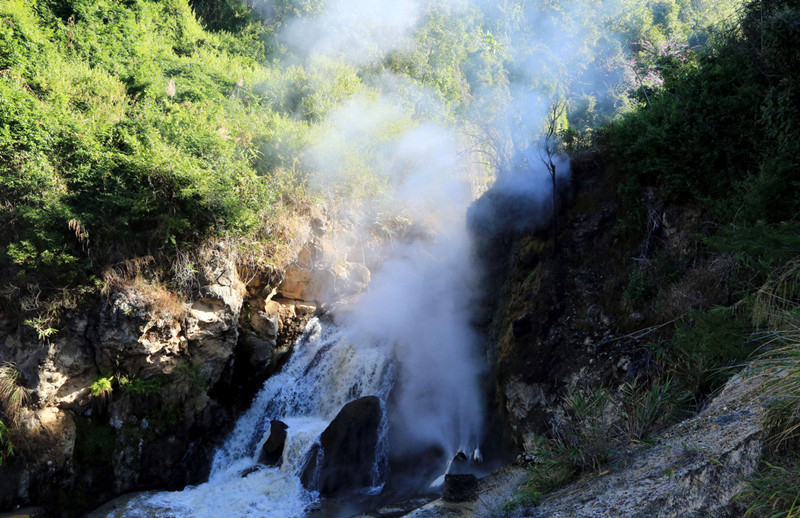
The Gaoligong Mountain is surrounded by scores of volcanoes, and therefore the Reserve is rich in geothermal resources. There are 4 scores of hot springs with marked curative effect on skin diseases and rheumatism. In the Reserve, steams and waterfalls can be seen here and there. Tingming Lake on the top of the mountain is a crate lake formed several hundred years ago, and it is limpid and transparent.
Hoolock gibbons in the Gaoligong Mountains, southwest China's Yunnan Province
What to See
Plants in Gaoligong Mountain National Nature Reserve
Vegetation here is vertically and obviously distributed into 9 types, including monsoon evergreen broadleaved forest, temperate coniferous forest, mountain liverwort shrub, cold temperate grassy marshland, etc.
Recent research shows that there are more than 1,000 species of higher plants in the Reserve. The evergreen broad-leaved forest in the east and west mountain areas is one of the best-preserved forests in Yunnan Province. The evergreen broad-leaved forest here is mainly composed of camphor trees and camellia, etc. The Reserve is proper habitats of over 20 precious species such as Phoebe nanmu, and Tsuga Chinensis. In addition, it is rich in medicinal, oil, and fibrous plants and has preserved rare medicinal plants in China and the world as a whole.
Animals in Gaoligong Mountain National Nature Reserve
The unique geographical location and climate features make Gaoligong Mountain National Nature Reserve a paradise of wild animals. Hengduan Mountains extending from south to north was called by zoologists as the source of mammals", forming a complex fauna pattern with both new and ancient types and a feature of transition from south to north. Among a great variety of animals, there are over 30 species under state protection such as antelopes, Hylobates hoolock leuconedys, Nycticebus coucang bengalensis, clouded leopards and civets. Among them, antelopes that enjoy the same reputation with giant pandas and golden monkeys are indigenous animals of Gaoligong Mountain. There are more than 300 species of birds such as silver pheasants, golden pheasants, peacocks, sunbirds and various Garrulax canorus.
It is an ideal choice for travelers visiting Gaoligong Mountain in May. Travelers can enjoy the charming landscape and favorable weather, without much rain.
Useful Travel Tips
There are many rare plants and animals in this natural reserve. Please protect them carefully.
What Makes It Special
Attraction Highlights
UNESCO
UNESCO World Heritage and Biosphere Reserve
Gaoligong Mountain is part of the Three Parallel Rivers of Yunnan Protected Areas, inscribed as a UNESCO World Heritage Site in 2003, and the range has also held UNESCO Biosphere Reserve status since 2000.
WILDLIFE
Home of the Skywalker Hoolock Gibbon
Scientists described the Skywalker hoolock gibbon (Hoolock tianxing) from Gaoligong forests in 2017; the range is counted among Asia's richest temperate biodiversity hotspots, holding thousands of vascular plant species and many endemics.
BIRDING
Baihualing Birdwatching Village
Baihualing village on the Baoshan side is one of China's best-known birdwatching sites, with more than 300 bird species recorded nearby; villagers work as guides and keep feeding and water stations for visiting photographers.
HISTORY
Old Southern Silk Road Crossings
Caravans of the ancient Southern Silk Road linking Sichuan with Myanmar and India crossed these mountains via Baoshan and Tengchong, and stone-paved trails and old passes still survive in the forest.
NATURE
Steep Valleys to Cloud Forest Summits
The range divides the Salween (Nujiang) and Irrawaddy watersheds, climbing from subtropical river gorges to summits above 4,000 metres, with cloud forest, waterfalls, hot springs and sharply layered vegetation zones.
EXPERIENCE
Best Season for Trekking
The dry months from October to April give the clearest skies for hiking old caravan trails, while March and April bring rhododendron blooms at higher elevations; the summer monsoon makes trails muddy and wildlife harder to spot.
Internal Transport
Hiking trails
The reserve is explored on foot via trails from gateway villages such as Baihualing; these trails are not connected by an internal shuttle.
Local access roads
Private cars, taxis and local buses reach trailheads and village entrances on public/local roads; these are not an internal scenic-area shuttle.
Sector-to-sector travel
Moving between Baoshan sectors requires public intercity bus or private vehicle on provincial roads; there is no reserve-wide sightseeing cart or cable car.
Tips: Plan independent transport to your chosen trailhead or gateway village and confirm access rules with the local reserve station; do not expect a reserve-wide shuttle or combined ticket.
The 1 Day Tengchong Rehai Hot Spring Tour offers a relaxing and rejuvenating experience in one of Yunnan’s most famous hot spring destinations. Tengchong, located in the western pa...
Discover Tengchong, one of China’s most renowned geothermal destinations, on this relaxing and culturally rich 3-day journey. Begin your adventure at the Rehai Hot Spring Scenic Ar...
Welcome to YasoTrip’s 4-Day Western Yunnan Birdwatching Tour,this is a meticulously crafted nature exploration journey designed specifically for bird enthusiasts. We will take you ...
Lijiang - Shangri-La - Benzilan Town - Feilaisi - Bingzhongluo - Fugong County - Lushui City - Tengchong
12 Days10 Places
This overland tour of the Three Parallel Rivers region in Yunnan promises an unforgettable journey through some of China’s most spectacular landscapes and culturally rich destinati...
This guide will take you to the western border of Yunnan Province to enjoy the beautiful scenery of Baoshan, the volcanic hot springs of Tengchong, the border trade style of Ruili ...
Baoshan - Baihualing - Heshun Ancient Town - Tengchong
5 Days4 Places
Go and give yourself a challenging but beautiful hiking tour in Yunnan, meet "the azaleas King in the world" and find the eight famous flowers in Gaoligongshan. Futhermore, Gaoligo...
Kunming - Anning - Chuxiong - Dali - Yangbi County - Baoshan - Mangshi - Ruili - Yingjiang County - Tengchong
9 Days12 Places
This 9-day self-driving tour takes you through Yunnan’s most historically significant roads: the Stilwell Road (史迪威公路) and the Yunnan-Burma Road (滇缅公路), both vital during China’s W...
Journey with us into deep lush forests, an area so remote that it still remains largely undiscovered by the discerning birder, as we journey into these rich sub-tropical forests an...