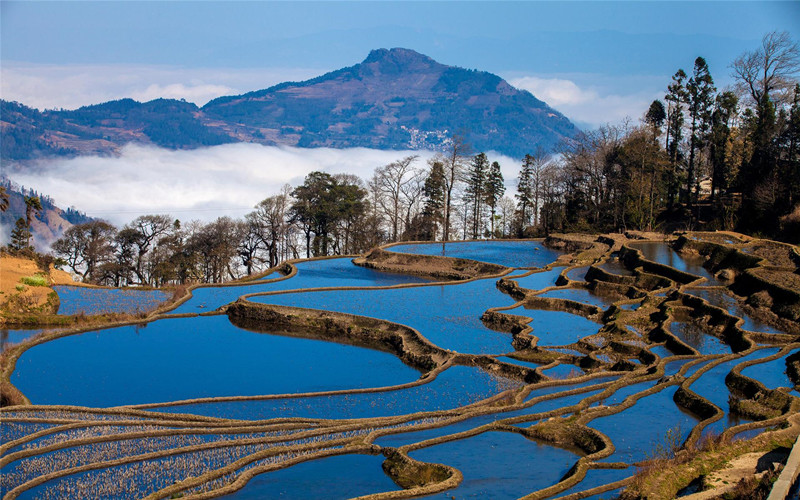
Yuanfu Village (元甫村), formerly known as Xiaobangka (小蚌嘎), belongs to Wuhe Community in Wuhe Township, Tengchong City. Recognised as a traditional village at the Tengchong municipal level, it is located at the foot of a branch of the Gaoligong Mountains, near a bend in a tributary of the Longchuan River. The settlement has a history of more than 300 years. Its founding ancestor, Shang Yuanfu (尚元甫), moved here during the Kangxi reign of the Qing Dynasty. Today, most villagers share the Shang surname.
Set against the mountains and facing farmland, the village is surrounded by layers of terraced fields. It is one of the best places to appreciate the terraced landscape of Wuhe Township. With very little commercial development, Yuanfu retains an authentic rural atmosphere and traditional village character. It is an appealing destination for countryside photography, exploring historic villages and enjoying a short rural getaway.
Key Attractions
Wuhe Terraced Fields
The terraced fields of Yuanfu are the village's most distinctive attraction. They follow the natural contours of the mountains, forming successive layers across the slopes and offering expansive views. The scenery changes dramatically throughout the year. During spring irrigation, the water-filled terraces reflect the sky, clouds, and distant mountains like mirrors. In summer, the young rice plants create broad expanses of vivid green, while autumn brings golden ears of rice. In winter and early spring, the terraces are complemented by blooming rapeseed flowers, adding softer colours and depth to the landscape.
These terraces are a relatively little-known photography destination in southern Tengchong, attracting far fewer visitors than the famous rice terraces of Yuanyang and Longling.
Shang Family Ancestral Hall and Traditional Houses
The village preserves the Shang Family Ancestral Hall (尚氏宗祠), a place where members of the Shang clan gather for ancestor worship and community activities. It also serves as an important cultural centre for the settlement. Its traditional timber construction reflects the architectural techniques of western Yunnan, with simple woodcarvings decorating the beams, frames, doors, and windows.
Scattered throughout the village are several century-old residences, many built with volcanic-stone walls and traditional timber column-and-tie structures. Their quiet courtyards retain old hearths, farming tools, and traditional furniture, creating a strong sense of rural heritage and everyday life.
River Bend and Ecological Landscape Around the Village
A small river winds around the settlement, with dense bamboo and trees growing along its banks. The water flows gently past shallow stretches and old stone bridges. Walking paths follow parts of the river, where water buffalo and domestic poultry can often be seen near the water.
These riverside scenes provide particularly authentic settings for rural photography. The stream also supplies water to the surrounding terraces, forming an essential part of the village's landscape and agricultural environment.
Mountain Tea Gardens and Ancient Tea Trees
Tea gardens cover many of the surrounding hillsides, interspersed with scattered ancient tea trees. Yuanfu lies within the Wuhe tea-growing area, where visitors may have opportunities during the tea season to observe tea picking and preliminary processing.
Local tea workshops produce tea from old tea trees, and visitors can sample traditional Tengchong large-leaf tea (腾冲大叶种茶). Combining the ancient village, terraced fields, and tea gardens makes for an enjoyable ecological and cultural photography route.
Local Customs and Traditional Farming Life
The village's culture is primarily rooted in Han Chinese agricultural traditions. Customs associated with the opening of the rice-planting season (开秧门) and tasting newly harvested rice (尝新米) are still observed. During festivals, visitors may encounter local lantern performances and folk songs.
Everyday agricultural activities such as drying grain, weaving bamboo utensils, and pressing tea oil also remain part of village life. Rather than staged cultural performances, what visitors see here is largely the genuine daily routine of local residents.
Local Specialities
For local food, head to Wuhe Township Centre, where restaurants serve traditional Tengchong farmhouse dishes. Recommended options include Tengchong thin-sliced pork (腾冲大薄片), clay-pot casserole (土锅子), rice-pea flour paste (稀豆粉), preserved pickled vegetables (腊腌菜), fire-roasted pork (火烧肉), local free-range chicken, and wild mountain vegetables. During the fresh tea season, visitors may also be able to try tea-leaf omelettes and freshly brewed local tea.
Travel Guide
Best Time to Visit
The dry season, from November to April, generally offers clear skies and good visibility, making it ideal for photographing the terraces and their changing light. Rapeseed flowers usually bloom between February and March. The spring irrigation period in April and May is particularly rewarding for mirror-like reflections across the water-filled terraces. September and October bring golden rice fields and a strong harvest-season atmosphere.
From June to August, the rainy season makes the landscape especially green and lush, although mountain roads can become slippery and morning mist is common.
Early morning and late afternoon are the best times to visit, when the light is softer and the scenery is especially atmospheric.
Getting There
Driving is the most convenient option. From downtown Tengchong, take the Baoshan–Tengchong Expressway towards Wuhe, then transfer to the rural road after leaving the expressway. The journey takes approximately 40 minutes. The road into the village is paved, and a basic open parking area is available near the entrance.
By public transport, take a bus from Tengchong to Wuhe Township Centre, then hire a local vehicle or taxi to reach Yuanfu Village. Bus services are limited, so this option offers less flexibility.
The village is best explored on foot. Its terraced-field paths are generally gentle and suitable for leisurely walks.
Admission
Entry to the village, terraced fields, riverside areas, and the exterior of the ancestral hall is free. Tea experiences and meals at local farmhouses are charged separately.
Food and Accommodation
Only a small number of households in the village receive visitors, and there are no standardised guesthouses. Most travellers choose to stay in Wuhe Township Centre, where restaurants and basic accommodation are available. Those seeking more extensive facilities can return to downtown Tengchong.
The village has only a few small shops with limited supplies, so it is advisable to bring drinking water and snacks in advance.
Suggested Itineraries
Half-Day Rural and Cultural Route: Stone marker at the village entrance → Shang Family Ancestral Hall → Historic lanes and traditional houses → Terraced-field viewpoint → Walk around the river bend.
One-Day Circular Route: Yuanfu Village and its terraced fields → Palian Dai Ancient Village (帕连傣族古寨) → Longchuan River Bridge viewpoint.
Travel Tips and Precautions
-
The terraced fields are agricultural land belonging to local households. Avoid stepping on rice seedlings or mature crops when taking photographs. If entering the narrow field ridges, watch your footing and take care not to damage the crops.
-
The ancestral hall is a place for clan gatherings and ceremonies. Keep quiet when visiting, do not enter private residential courtyards without permission, and ask before photographing villagers.
-
The soil beside the river and along the terrace ridges can be soft and slippery, especially after rain. Take care when walking and stay away from deep sections of the river.
-
Ultraviolet radiation can be strong in the mountains, while temperatures may vary considerably between morning and evening. Bring sun protection and a light jacket. Mosquitoes and other insects are common in summer and autumn, so carry insect repellent.
-
The traditional village environment is ecologically fragile. Take all rubbish with you and avoid picking wild flowers or plants.
-
Fire prevention measures are strictly enforced in the surrounding woodland during the dry season. Smoking and open flames are prohibited on hillsides, in tea gardens, and in forested areas.
-
There are no large purpose-built viewing platforms for the terraces. Viewpoints are scattered throughout the area, making this a destination best explored slowly on foot.