





Yunnan Guide
  • Yunnan Guide
  • Travel Tips
  • Tour Planing
  • Ethnic Culture
  • Yunnan Climate
  • Golf Courses
  • Travel Articles
  • Shibaoshan Folk Song Festival of Bai Ethnic Minority in Jianchuan County, Dali

    09/07/2018Crazy Jone7241 wordsAbout 25 minutes

    Chinese Name: 石宝山歌会
    English Name: Shibaoshan Folk Song Festival of Bai Ethnic Minority in Jianchuan County, Dali
    Location: Jianchuan County, Dali, Yunnan Province (云南省剑川县石宝山)
    Heritage Level: National Intangible Cultural Heritage
    Heritage Number: X-105

    The Shibaoshan Folk Song Festival (石宝山歌会) is one of the most iconic and ancient traditional festivals of the Bai ethnic group (白族) in Yunnan Province. With over 1,000 years of history, this annual celebration takes place in Shibaoshan Mountain (石宝山), located in Jianchuan County (剑川县), Dali (大理). It has been officially recognized as a National Intangible Cultural Heritage since 2008. The festival is a unique expression of Bai culture, combining music, dance, folklore, and community bonding.

    The festival typically occurs between the 27th day of the 7th lunar month and the 1st day of the 8th lunar month, during which Bai communities from Jianchuan, Eryuan, Lijiang, Dali, and Lanping converge in Shibaoshan. The celebration features Bai antiphonal singing (白族对歌), traditional dances, and spiritual rituals. For many Bai youths, it’s a time for courtship and finding a life partner through songs and performances.

    Historical Origins

    The Shibaoshan Folk Song Festival has a long and rich history. It can be traced back to the Tang Dynasty (618–907), with records indicating that the festival's style of antiphonal singing — known as "Mountain Flower Style" (山花体) — was practiced as early as that period. According to historical texts such as the Tang Dynasty's "Man Shu" (蛮书), this style of singing involved young people traveling together and expressing their feelings through songs.

    During the Qianlong period (1736–1795) of the Qing Dynasty, Bai people from Sichuan migrated to Shibaoshan. This migration contributed to the establishment of the festival as it became a way for Bai people to express their cultural identity, love, and community bonds.

    In the 20th century, the festival faced a period of suppression. In the late 1950s, influenced by political movements, the Shibaoshan Folk Song Festival was temporarily banned. However, by the 1980s, the festival began to be revived, with the government encouraging the creation and performance of Bai folk songs during the festival. The growing tourism industry in Jianchuan County further fueled the festival's popularity, transforming it into a symbol of Bai cultural heritage.

    Main Activities

    The Shibaoshan Folk Song Festival is a vibrant celebration of Bai culture, featuring numerous activities that highlight the artistic and communal aspects of Bai life.

    1. Folk Song Performances

    At the heart of the festival are the Bai folk song performances. The most iconic feature of the festival is the antiphonal singing (对歌), where singers from different communities take turns singing to one another. The "Mountain Flower Style" (山花体) involves the singer singing a song in four lines: the first three lines consist of seven characters, and the fourth line has five characters. The songs, often about love, nature, and daily life, are accompanied by the traditional sanxian (三弦), erhu (二胡), and other musical instruments. This dynamic exchange of songs is a platform for courtship and a means of strengthening community ties.

    2. Traditional Bai Dances

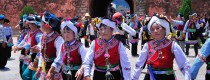
    Alongside the folk song performances, traditional Bai dances are performed by groups of dancers. Dressed in colorful and elaborate costumes, dancers perform to the rhythm of Bai folk songs. These dances are a celebration of Bai culture and range from group performances to solo dances that express emotions, gratitude, and unity.

    3. Cultural Exhibitions

    The festival also hosts cultural exhibitions that showcase various aspects of Bai art, crafts, and history. Visitors can explore traditional handicrafts, such as embroidered textiles, silver jewelry, and wood carvings. These exhibitions provide an opportunity for festival-goers to gain insight into the Bai people's rich artistic heritage.

    4. Bai Cuisine

    Local food vendors at the festival offer a wide variety of Bai cuisine, such as smoked meats, rice cakes, and traditional stir-fries. The food is an integral part of the cultural experience, allowing visitors to taste the flavors of the region. Special dishes often prepared during the festival include Bai hotpot and steamed rice with vegetables.

    5. Competitions and Contests

    The festival features various singing competitions, dance contests, and traditional games. Competitions are held on the "Song Contest Stage" (赛歌台), where singers showcase their vocal skills in a friendly rivalry. These competitions serve not only to entertain but also to encourage the continuation of Bai folk traditions and provide a space for the younger generation to display their talents.

    6. Workshops and Interactive Activities

    In addition to performances and exhibitions, the festival often offers workshops on traditional Bai music and dance. Attendees can learn about Bai instruments such as the sanxian and suona (唢呐), as well as gain hands-on experience in Bai dance steps and song techniques.

    7. Religious and Cultural Rituals

    During the festival, locals visit temples such as Baoxiang Temple (宝相寺) to offer incense and engage in Buddhist rituals. Traditional Bai religious ceremonies, including the "Acha Li" (阿吒力) Buddhist prayers and "A Yang Bai" (阿央白) worship, are performed as part of the festival's spiritual activities.

    8. Community Bonding and Social Gatherings

    The festival serves as a community gathering where Bai people from different regions come together to celebrate their shared cultural identity. It is a time for people to reconnect with family and friends, as well as make new acquaintances.

    9. Outdoor Activities

    Given the picturesque setting of Shibaoshan, festival-goers can also enjoy outdoor activities such as hiking and exploring the ancient stone carvings and temples that dot the landscape. The region's natural beauty adds a unique dimension to the festival, providing a serene backdrop for the festivities.

    Cultural Significance

    The Shibaoshan Folk Song Festival is not only a time of celebration but also serves as a critical platform for the preservation of Bai culture. As the cradle of Bai folk songs, the festival showcases Bai music, dance, and storytelling, all of which are essential to understanding the Bai people's way of life.

    The festival is viewed as an important cultural repository that contributes to various academic fields such as anthropology, ethnology, archaeology, and aesthetics. Professor Zhang Yaqin from Yunnan University notes, “This festival provides valuable information for the study of Bai folk songs, rituals, and customs, offering insights into Bai history and traditions.”

    Preservation and Protection

    Heritage Protection

    The Shibaoshan Folk Song Festival was officially included in the National Intangible Cultural Heritage List in 2008. Since then, efforts have been made to protect and promote the festival, with the involvement of local cultural departments. The Jianchuan County Cultural Bureau (剑川县文化局) plays a key role in organizing the festival and ensuring its sustainability.

    Challenges to Preservation

    As modernity and globalization influence local cultures, traditional practices like Bai folk songs face challenges in retaining their appeal among younger generations. Many youth are increasingly drawn to pop music and modern entertainment, leading to a decline in interest in traditional music. Additionally, economic pressures make it difficult for families to encourage their children to pursue traditional arts, as many fear that these skills will not provide sufficient income.

    Protection Measures

    To safeguard the festival, Jianchuan County has implemented various protection measures, including the "Song Contest Stage" and incentive-based competitions. These initiatives aim to keep the tradition alive and accessible to future generations. In 2023, the Shibaoshan Folk Song Festival Project received a positive evaluation from the Jianchuan Cultural Bureau, ensuring that the festival's preservation efforts are successful.

    Cultural Stories and Legends

    The Shibaoshan Folk Song Festival is also rich in local legends. One famous story is about a beautiful Bai singer who sang for three days and nights at Baoxiang Temple (宝相寺), eventually passing away peacefully in the arms of her music. Locals believe she was the “Goddess of Song” (曲神), and they built a grave for her at Shibaoshan. Now, every year, festival-goers visit her tomb and offer prayers before they begin their singing.

    ENQUIRY

    Have a question before booking? Message us to learn more.
    Click to change