Guodazhai Yi and Bai Ethnic Township (郭大寨彝族白族乡) is under the administration of Fengqing County (凤庆县), Lincang City (临沧市), Yunnan Province (云南省). It is located in the southwest of Fengqing County, bordered by Xueshan Town (雪山镇) and Xingfu Town (幸福镇) of Yun County (云县) to the east, Wumulong Township (乌木龙乡) of Yongde County (永德县) to the south, Yingpan Town (营盘镇) to the west, and Sancahe Town (三岔河镇) to the north. The township covers an administrative area of 253.37 square kilometers. By the end of 2019, its registered population was 22,335.
Before 1949, it was under Qiongying Township (琼英乡). In March 1988, it was reorganized into Guodazhai Yi and Bai Ethnic Township. As of June 2020, the township administers 11 villages, with the township government located in Guodazhai Village (郭大寨村). In 2019, the township had 17 industrial enterprises and 5 supermarkets or stores with an operating area of over 50 square meters.
Key Information:
- Administrative Category: Township
- Area: 253.37 km²
- Administrative Villages: 11
- Government Seat: Guodazhai Village (郭大寨村)
- Postal Code: 675907
- Area Code: 0883
- Population: 22,335 (2019)
- Climate: Subtropical mild climate
Historical Evolution
- Late Qing Dynasty to early Republic of China: Part of Aduwuli Second Jia.
- Before 1949: Belonged to Qiongying Township (琼英乡).
- 1950: Part of the Sixth District.
- 1953: Divided into the Seventh District.
- 1959: Established as Guodazhai Commune.
- 1962: Commune reorganized into a district.
- 1966: Several communes including Wumulong were reassigned to Yongde County (永德县).
- 1969: District changed back to commune.
- 1984: Commune reorganized into a district.
- March 1988: District abolished and Guodazhai Yi and Bai Ethnic Township established.
Administrative Divisions
As of June 2020, Guodazhai Yi and Bai Ethnic Township governs 11 villages:
- Dalise Village (大立色村)
- Kasi Village (卡思村)
- Pingzhang Village (平掌村)
- Wende Village (文德村)
- Ganma Village (干马村)
- Guodazhai Village (郭大寨村)
- Qiongying Village (琼英村)
- Songlin Village (松林村)
- Banggui Village (邦贵村)
- Tuanshan Village (团山村)
- Luojiazhai Village (罗家寨村)
Geographic Environment
Location
The township lies in the southwest of Fengqing County (凤庆县), bordered by Xueshan Town (雪山镇) and Xingfu Town (幸福镇) to the east, Wumulong Township (乌木龙乡) of Yongde County to the south, Yingpan Town (营盘镇) to the west, and Sancahe Town (三岔河镇) to the north. The total area is 253.37 km².
Topography
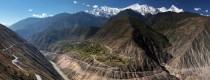
Most of the township is mountainous, with typical karst landforms. The highest peak is Wanming Mountain (万明山) at 2,905 meters above sea level, while the lowest point is Daxinqiao in Songlin Village (松林村), at 1,398 meters.
Climate
The township has a subtropical mild climate characterized by mild winters and summers. The average annual temperature is 16.5°C, and the average annual precipitation is 1,506 mm.
Hydrology
The largest river is the Yalang River (雅琅河), originating in Yongde County, flowing through Banggui, Guodazhai, Dalise, and Qiongying Villages before merging with the Lianghe River (两岔河) and eventually entering the Shundian River (顺甸河). The river stretches 20.6 km within the township, with an average annual flow of 4.9 m³/s. Major tributaries include Libaluo River (立巴罗河), Mafengcun River (麻疯村河), and Shuimo River (水磨河).
Population
By the end of 2011, the township had a total population of 22,036, including 400 permanent urban residents, with an urbanization rate of 1.8%. The population consisted of 11,653 males (52.8%) and 10,383 females (47.2%). The ethnic composition was mainly Han (68.2%), Yi (22.9%), and Bai. By 2019, the registered population had increased to 22,335.
Travel Tips
- Altitude: Ranges from 1,398 m to 2,905 m. Be prepared for altitude variations if trekking in mountainous areas.
- Climate: Mild and comfortable year-round. Light jackets are recommended in the evenings.
- Best Season to Visit: Spring and autumn, when rainfall is moderate and temperatures are pleasant.
- Transportation: Local roads connect the township to Fengqing County (凤庆县) and neighboring towns, but travel time may be longer due to mountainous terrain.
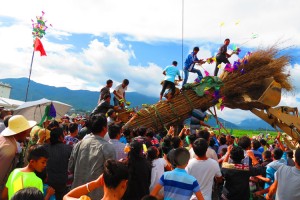
- Local Culture: Home to Yi and Bai ethnic groups. Visitors may experience traditional festivals, songs, and dances.
- Food: Local cuisine is influenced by Yi and Bai traditions, featuring corn, buckwheat, and cured meats.