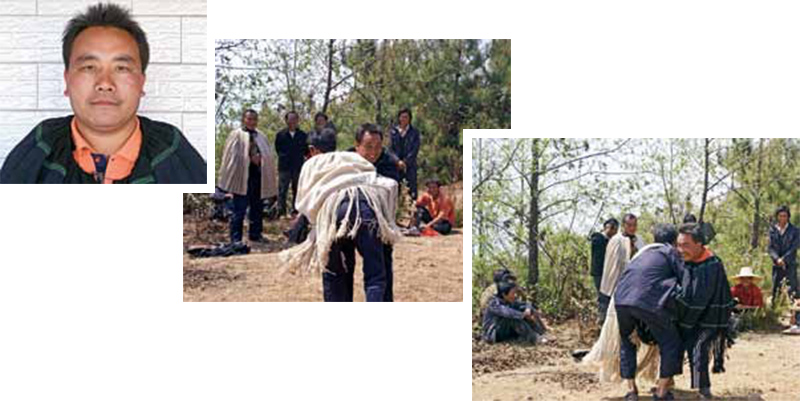
Pu Jinliang, a provincial-level inheritor of Yi-style wrestling from Liangshan Township (凉山乡), Yuanmou County (元谋县), Chuxiong Prefecture (楚雄州), has dedicated more than 70 years to preserving and innovating this traditional art. Coming from a family where wrestling has been passed down for generations, he transformed Yi wrestling—known as “Ge” (格)—from a village sport into a cultural symbol, earning the title of “Living Guardian of Xiaoliangshan Wrestling Heritage.”
Born in 1974 in Damai Village (大麦冲村), Pu Jinliang grew up in a wrestling family. At the age of 6, he began training under renowned wrestlers Peng Dechang (彭德昌) and Pu Jianguo (普建国), later becoming a disciple of Peng Jinfu (彭金福).
Over years of rigorous practice, he mastered more than ten wrestling techniques, including throws, leg sweeps, chest locks, and back flips. His specialty lies in “Mianyi” (缅依, bear hug throw) and “Woer” (我尔, chest throw), techniques that allow for quick victory. He achieved silver and bronze medals in the Chuxiong Prefecture Ethnic Games.
Yi wrestling is not just a sport but a living memory of the Yi people (彝族). Originating during the Tang Dynasty (唐代), it was initially military training against invaders, later evolving into a popular feature of festivals and weddings. Pu emphasizes this spirit of “wrestling as a defense of the homeland,” ensuring that the tradition is not only about physical skill but also about cultural pride.
Pu Jinliang began training students at the age of 18. To date, he has mentored more than 20 inheritors, some of whom, like He Jianzhong (何建忠) and He Yuangui (何元贵), have become champions at the prefectural and provincial level.
Family Tradition + Community Teaching: He teaches practical combat skills within his family workshop and combines them with systematic instruction at the township training hall.
The “Three Hearts” Principle: Students are expected to train with reverence for ancestors, dedication to skills, and a strong sense of responsibility for cultural inheritance. Daily practice can exceed eight hours and includes learning Yi rituals and wrestling chants.
In Schools: Partnered with Liangshan Township Central Primary School (凉山乡中心完小), he runs wrestling classes twice a week, training over 80 students.
Digital Promotion: Short videos of his training sessions have gained over one million views, attracting learners from across China.
Tournaments: He organizes the “Liangshan Yi Wrestling Invitational” (凉山乡彝族摔跤邀请赛), featuring youth, adult, and women’s divisions, with growing sponsorships and participation from more than 200 athletes annually.
Contributed to the Wrestling Protection Plan of Yuanmou County (元谋县).
Helped Yi wrestling enter the National Intangible Cultural Heritage List (2011).
Created a digital archive using 3D scanning for 108 wrestling moves.
Co-authored the textbook Xiaoliangshan Yi Wrestling Guide (小凉山彝族摔跤教程) with Yunnan Minzu University.
Recognized five times as an “Outstanding Inheritor” and honored as a “Yi Craft Master” (彝乡名匠).
Cultural Performances: Regular wrestling shows at Yuanmou Man World Park (元谋人世界公园) and Liangshan Torch Village (凉山乡火把彝村), attracting over 100,000 visitors yearly.
Cultural Products: Developed Yi wrestling-themed souvenirs such as wooden carvings and embroidered motifs, with strong online sales.
Festival Branding: Organizes large-scale wrestling competitions during the Torch Festival (火把节), drawing national media attention and making Liangshan Township a cultural tourism hotspot.
His wrestling team includes Yi (彝族), Lisu (傈僳族), and Han (汉族) members, fostering inter-ethnic friendships. The team has been recognized as a “Demonstration Group for Ethnic Unity and Progress in Yunnan Province.”
Despite success, Pu faces two major challenges:
Aging Practitioners: Wrestling requires 5–8 years of training. Most of his disciples are around 45 years old, with very few under 30.
Limited Market Support: Equipment and competition prizes remain costly, restricting growth.
Policy Support: Secured government heritage funds to purchase training gear and provide student stipends.
Education Partnerships: Built a Yi Wrestling Training Base with Chuxiong Normal University (楚雄师范学院).
Digital Innovation: Collaborated with Huawei’s “Digital Heritage” (数字非遗) project to launch a VR wrestling training system, reaching over 5 million views on the Xuexi Qiangguo (学习强国) platform.
Pu Jinliang’s efforts embody three key values:
Historical Research: Preserves chants and rituals essential for studying Yi military and cultural history.
Sports Development: Integrated Yi wrestling into the official events of the National Ethnic Games.
Cultural Identity: Represented Yuanmou County at international cultural festivals in Malaysia and Thailand, promoting Chinese culture globally.
As Pu often says:
“Wrestling is not just about falling and standing up again—it is the courage of our ancestors living on in today’s world.”
Through resilience and innovation, Pu Jinliang ensures Yi wrestling (彝族摔跤) continues to thrive, standing as a vivid example of China’s cultural diversity and unity.