7 Days GolfingTour
 8 Days Group Tour
 8 Days Yunnan Tour
 7 Days Shangri La Hiking
 11 Days Yunnan Tour
 6 Days Yuanyang Terraces
 11 Days Yunnan Tour
 8 Days South Yunnan
 7 Days Tea Tour
 8 Days Muslim Tour
 12 Days Self-Driving
 4 Days Haba Climbing
 Tiger Leaping Gorge
 Stone Forest
 Yunnan-Tibet
 Hani Rice Terraces
 Kunming
 Lijiang
 Shangri-la
 Dali
Dali
 XishuangBanna
 Honghe
 Kunming
 Lijiang
 Shangri-la
 Yuanyang Rice Terraces
 Nujiang
 XishuangBanna
 Spring City Golf
 Snow Mountain Golf
 Stone Mountain Golf
Embroidery of Azhuodi Yi Ethnic Minority (Sani People) in Shilin County, Kunming
Overview of Yi (Sani) Embroidery
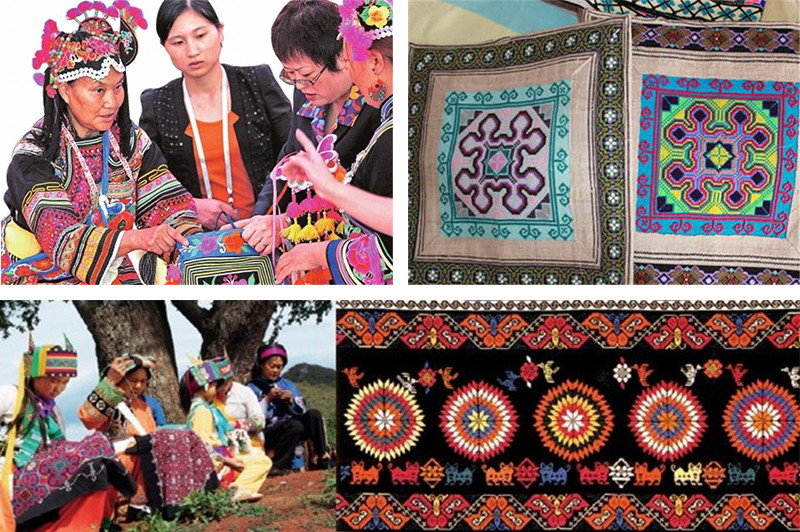
Yi (Sani) embroidery, also known as “Sani Cross-Stitch” or “Sani Tiao Hua” (撒尼挑花), is a folk embroidery art that originates from the Sani people living in Shilin Yi Autonomous County in Yunnan. The Sani people belong to a branch of the Yi ethnic group, and their embroidery art has been passed down through generations. It is believed to have originated in the Tang and Song dynasties and matured during the Ming and Qing dynasties.
This embroidery is characterized by its fine stitches, exquisite craftsmanship, clever design, harmonious structure, and vibrant colors. It showcases the intelligence and artistic creativity of the Sani people, reflecting distinct ethnic styles and local features.
On June 7, 2008, Yi (Sani) embroidery was included in the second batch of China’s national intangible cultural heritage list by the State Council of the People’s Republic of China, with heritage number VII-78. On May 15, 2018, it was also included in the first batch of the National Traditional Craft Revitalization Directory.
Historical Origins
Sani embroidery, also referred to as “Sani Tiao Hua” in the Sani language (meaning “unfinished embroidery”), is believed to have originated in the Tang and Song dynasties and became more refined during the Ming and Qing dynasties. It is mainly practiced by Sani women in towns such as Guishan, Changhu, Xijiekou, Lumei, Lufu, and Banqiao in Shilin County, as well as in neighboring areas like Luxi County, Mile County, Luliang County, Yiliang County, and Qiubei County in Wenshan Zhuang and Miao Autonomous Prefecture.
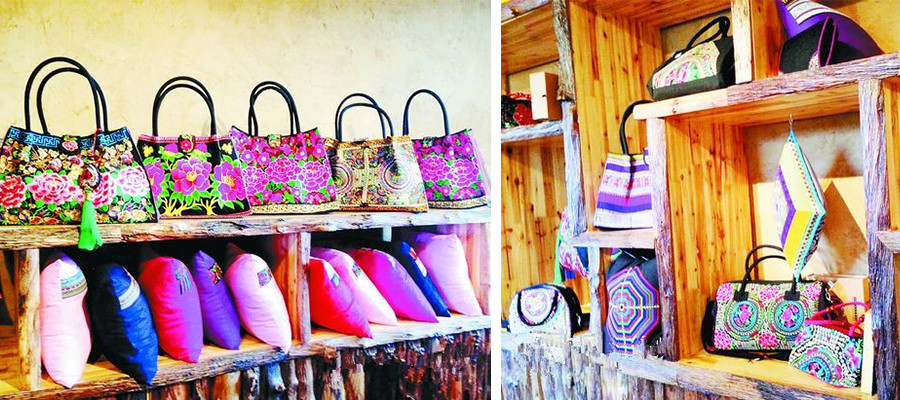
Before the Reform and Opening-up, Sani embroidery was mostly produced for personal use, and few items were sold as commodities. In the late 1980s, with the growth of tourism in Shilin, both domestic and international tourists began to buy Sani embroidery. This demand led to a small number of Sani women seizing the opportunity to sell various products like wallets, handbags, wall hangings, waistbands, and cushions, opening a new avenue for the Sani people to engage in the market economy.
As the manual embroidery process is time-consuming, it became difficult to meet market demand with handcrafts alone. Consequently, Sani embroidery transitioned from traditional home-based production to factory-based mass production, incorporating modern assembly-line processes.
Cultural Features
Embroidery Patterns
Traditional Sani embroidery patterns can be broadly divided into three categories:
- Geometric Patterns: These are primarily cross-stitch designs, with a degree of abstraction. Notable examples include the “three-string flower,” “octagonal flower,” “copper coin flower,” “sunflower,” “sheep horn flower,” “butterfly flower,” “pomegranate pattern,” “frog pattern,” “tree pattern,” “dog tooth pattern,” “fern pattern,” “flame pattern,” “jumping pattern,” and simple geometric shapes like diamonds, triangles, and stripes.
- Floral Patterns: These are mainly executed in flat stitch, showcasing delicate and realistic techniques. These designs often draw inspiration from common flowers like lotus flowers, pomegranate flowers, azaleas, and camellias.
- Cut-out and Attached Flowers: These patterns are more abstract and bold, with examples including cloud patterns and wave patterns.
Pattern Compositions
Sani embroidery is usually composed of two main types of patterns:
- Square or Circular Patterns: These designs are simple and symmetrical, often featuring a complete three-string flower or octagonal flower pattern in the center, with surrounding stripes like sheep horn patterns and diamond shapes. These patterns are commonly found on smaller items such as waistbands and backpacks.
- Long, Repeating Patterns: These intricate designs typically feature larger floral motifs like the three-string flower or octagonal flower. The patterns are formed by repeating elements arranged in a circular manner, expanding outward. The design is often more complex and intricate, appearing on larger items such as tablecloths or wall hangings.
Color Matching
Sani embroidery typically uses simple, bright colors for the base fabric, such as black, deep blue, or white, with occasional use of other colors like yellow or red. There are two main styles of color matching:
- Vibrant Style: This uses contrasting colors of silk thread, such as black, yellow, green, red, blue, white, and cyan, creating strong contrasts and vibrant, eye-catching patterns.
- Elegant Style: This involves using a single color of silk thread on a solid-colored fabric to create a subtle, refined effect. An example is the use of black fabric with white thread, a style known as “Su Tiao,” where the stitching is simple yet elegant.
Embroidery Techniques
Sani embroidery is known for its focus on “challenging” stitches, using a mix of techniques such as cross-stitch and flat stitches. It involves two primary methods:
- Cross-Stitch (十字绣): This technique uses the “X” shape as the basic unit. The fabric is woven in clear, vertical and horizontal lines, and four adjacent points are joined diagonally with colored thread to form a tilted “X.”
- Single Stitch (一字绣): This technique uses the “I” shape as the basic unit, where the thread follows the horizontal lines of the fabric, creating continuous lines of “I” shapes to form the pattern. It is commonly used in smaller decorative items like waistbands and handbags.
In addition to these, techniques like “inserted flower” stitching (顺针平绣) and cut-out flower applique (镂空贴花) add depth and texture to the embroidery, allowing for more creative and complex designs.
Production Process
The creation of Sani embroidery involves three main steps:
- Fabric Cutting: The fabric is cut according to the size and shape required for the embroidery. The base fabric pieces are referred to as “embroidered pieces” (绣片).
- Embroidery: The embroidery is done following the design, starting from the central motif and expanding outward. The threads are carefully stitched, filling in different color blocks. For more complex designs, multiple layers of embroidery are stitched on top of each other.
- Finishing: This step involves edge finishing and joining multiple embroidered pieces together to create the final product. Depending on the design, the edges may be adorned with tassels, or several pieces may be stitched together into a larger artwork.
Preservation and Inheritance
Value of Inheritance
Artistic Aesthetic Value: Sani embroidery carries deep emotional significance, reflecting the love for nature and the aspiration for a beautiful life. The patterns are symbolic of the Sani people’s spirit and lifestyle.
Craftsmanship Value: Sani embroidery is a highly skilled craft that demands great patience, precision, and dedication. The intricate techniques are not easily replicated by modern mass production methods.
Practical Value: Embroidery is not only decorative but also functional, enhancing the durability of clothing, especially for Sani women who spend a lot of time working in the fields.
Academic Value: Sani embroidery serves as an important cultural marker, reflecting the psychological, spiritual, and aesthetic values of the Sani people, and is valuable for research into their customs, beliefs, and societal values.
Economic Value: As tourism has increased, Sani embroidery has become increasingly popular with tourists and collectors, bringing it beyond the Sani communities and integrating it into wider consumer markets.
Current Situation of Inheritance
Sani embroidery is a highly complex craft, and the skills required to create it are difficult to learn. In the face of technological advances and machine-produced alternatives, fewer young people are learning traditional handcrafting techniques. As older artisans retire, there is a concern that these traditional skills may be lost.
In the past, items like the Sani flower waistbands were an essential part of a woman’s dowry, but many of these beautiful works have now been lost to time. The increasing influence of external trends has led to a shift in craftsmanship, and traditional Sani embroidery may lose its ethnic and regional character.
http://www.ynich.cn/view-ml-11111-1200.html