Yunnan Guide
  • Yunnan Guide
  • Travel Tips
  • Tour Planing
  • Ethnic Culture
  • Yunnan Climate
  • Golf Courses
  • Travel Articles
  • The Style of Love and Marriage of Taliu Ethnic People
    31/12/2016Crazy Jone4925 wordsAbout 17 minutes

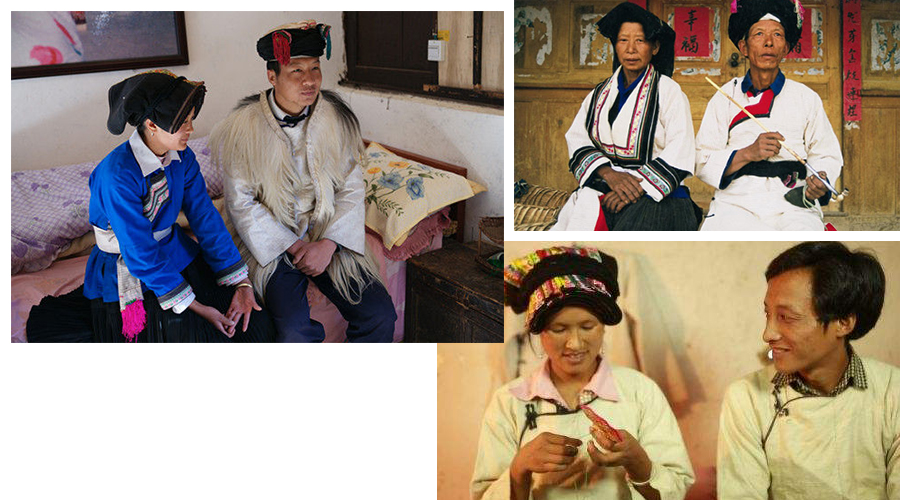
    The Taliu ethnic group, a sub-group within the broader Yi (彝族) community, has unique customs when it comes to love and marriage. Their traditional practices are deeply embedded in their culture, with some distinct elements such as the youth shelter and the Seven Challenges (过七关). These practices define the way young people meet potential partners and prepare for marriage.

    Youth Shelter: The Place for Love and Courtship

    In the Taliu (他留) community, the youth shelter (青春棚) is a place where unmarried young men and women meet to talk about love and find potential partners. It functions similarly to the "communal housing" (公房) common among many ethnic groups in Southwest China but differs in several key aspects. While "communal housing" involves many young men and women living together, the youth shelter is only for one young woman, and men have to visit different shelters.

    In the youth shelter, young women can entertain multiple suitors, and young men may visit several women. The interaction typically takes place at night, and the primary activity is conversation, with the aim of finding a suitable match. The relationship building continues until the couple becomes engaged. This unique courtship custom is a significant cultural trait of the Taliu people.

    The Meaning of "Youth Shelter"

    The term youth shelter does not exist in the Taliu language. Instead, the term "shelter" (棚) is used for houses, and several terms are used to describe the concept of the youth shelter:

    1. "Zuma Rika" (祖玛日喀), meaning "the place where a girl sleeps."

    2. "Cala Mohege" (擦拉么何各), where "Cala Mo" refers to a young girl, and "Hege" means shelter, so this term means "a young girl's shelter."

    3. "Hege Xhika" (何各峡喀), where "Xhika" means "play," so this term refers to "a playful shelter."

    The term "youth shelter" was coined in 1982 by a few local people, including Lan Shaozeng (兰绍增) and Lan Shaoji (兰绍吉). It has since spread and is frequently mentioned in media.

    Structure and Environment of the Youth Shelter

    In practice, the youth shelter is a small, modest building built by the girl's parents once she reaches adulthood. It is generally located in the courtyard and is either opposite the main house or attached as an auxiliary room. The shelter itself is very simple, often with a small area of about 7-8 square meters. The door is typically 1.6-1.7 meters high, and the roof is about 2 meters above the ground, supported by beams and covered with branches. Inside, there is usually a simple bed, a table, and a few personal items like a mirror, books, flowers, and photographs of famous celebrities.

    Though simple, the youth shelter is the space where young women spend several years, typically from their late teens to marriage, interacting with potential suitors and engaging in the courtship process.The Style of Love and Marriage of Taliu Ethnic People

    The "Seven Challenges" Tradition

    At the age of 15-16, Taliu boys and girls go through an important ritual of adulthood. For girls, the transition is marked by changing from a white skirt to a black skirt, symbolizing the change from childhood to adulthood. After this ritual, they are allowed to meet and interact with members of the opposite sex. However, before young women can receive suitors in their youth shelter or before men can visit the shelters, they must complete a process known as the Seven Challenges (过七关).

    The "Seven Challenges" is a traditional ritual that involves meeting and interacting with seven different people before a girl or boy is considered eligible for courtship. It is a sort of practice run for engaging with the opposite sex, where they must prove their ability to handle social relationships.

    How the Seven Challenges Work

    The process begins when a person who has already completed the Seven Challenges (referred to as A) introduces the person who is yet to undergo the challenges (B) to their first partner, who will help guide them through the challenges. The person introducing is responsible for ensuring that B meets all seven individuals.

    The challenges are as follows:

    1. "Chawu Dai" (查吾傣) – "The Beginning": A metaphor for starting a journey.

    2. "Chabuji" (查布矶) – "Crossing the Log Bridge": Symbolizing the beginning of a difficult task.

    3. "Chazhu" (查阿竹) – "Chopsticks": Represents the relationship's foundation, simple but essential.

    4. "Chaguo Luo" (查锅罗) – "Pot Stone": Refers to the complexities of relationships.

    5. "Chaliya" (查牙造) – "Weaving Loom": Symbolizes weaving together different aspects of life.

    6. "Chalvya" (查虑牙) – "Gourd": Represents the connection between individuals, with its distinct shape.

    7. "Chashuela" (查刷拉) – "Spinning Wheel": Symbolizes the continuous nature of relationships, as things are constantly changing.

    8. "Chadaiqiu" (查傣秋) – "Swing": Represents the ups and downs of relationships, symbolizing movement and change.

    Each challenge has a symbolic name related to an everyday object. For example, the log bridge suggests solitude and the challenge of standing alone, while chopsticks and gourds refer to simple, essential elements of daily life, but when combined, they suggest more complicated relationships. By completing the Seven Challenges, a young person is ready to begin a more serious relationship and gain the right to invite suitors into their youth shelter.

    Modern Changes in the Seven Challenges

    In the past, the Seven Challenges had to be completed on consecutive nights, which was a strict tradition. However, in modern times, these practices have become less rigid. For example, a 54-year-old woman from Shuanghe (双河) passed her Seven Challenges in a more relaxed manner, with each challenge being introduced by a different person, including friends and relatives.

    In modern times, the Seven Challenges have almost disappeared among young people, but the tradition remains an important part of Taliu culture and continues to influence the community's understanding of courtship and marriage.

    More About

    ENQUIRY

    Have a question before booking? Message us to learn more.
    Click to change