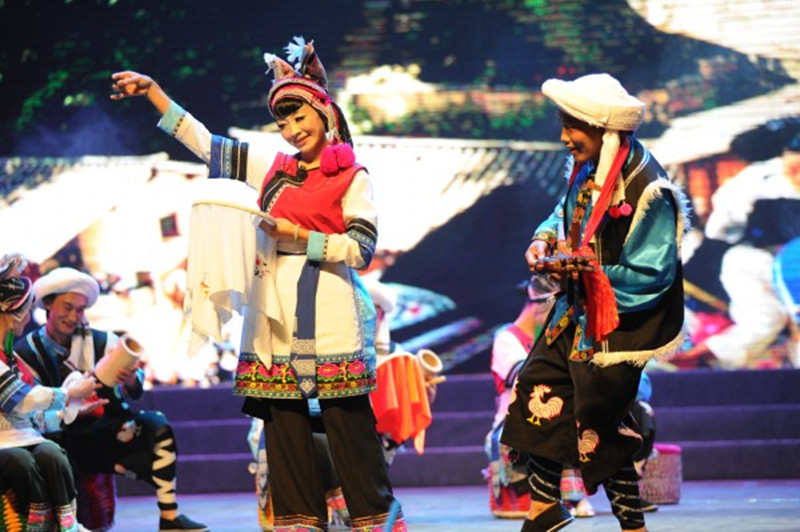
Li Baomei (born September 1978) is the provincial-level representative inheritor of Jianchuan Bai Opera (剑川白曲), an intangible cultural heritage of Dali Bai Autonomous Prefecture (大理白族自治州), Yunnan Province (云南省).
Her artistic journey reflects the transformation of this ancient folk singing tradition in Northwest Yunnan — from being sung only in villages and mountain gatherings to becoming a recognized part of national heritage. For more than 40 years, she has dedicated herself to preserving and innovating this art form, earning the title:
“The Nightingale of Shibao Mountain (石宝山上的百灵鸟).”
Early Inspiration & Awakening
Li was born in Shilong Village (石龙村), Shaxi Town (沙溪镇), Jianchuan County (剑川县), known as the “Town of Bai Songs.” From childhood, she was immersed in the Bai Opera culture of the Shibao Mountain Song Festival (石宝山歌会).
-
In 1995, at age 17, she debuted at the Shibao Mountain Song Festival with an improvised piece “Shibao Mountain Scenic Area” (石宝山景区), winning first prize.
-
In 2000, she began her professional career, working alongside the national-level inheritor Jiang Zongde (姜宗德).
-
In 2004, she achieved national fame — crowned “Song Queen” at the March Street Festival (山花杯 歌王歌后大赛), and awarded Best Folk Singer in a nationwide competition by China’s Ministry of Culture.
Her singing style blends the solemn chanting of Bai shamans (Bimo 毕摩) with the freshness of mountain folk songs, marked by clarity, improvisation, and emotional depth.
Core Skills & Cultural Preservation
Living Carrier of Ancient Songs
-
Ritual Integrity: She faithfully preserves the nine-step singing ritual — Inviting Spirits, Purification, Antiphonal Singing, Sending Spirits.
-
Authentic Repertoire: She retains classic pieces such as “The Wild Goose Carries a Letter” (鸿雁带书) and “Farewell Song” (出门调), recognized in the Anthology of Chinese Folk Songs – Yunnan Volume (中国民间歌曲集成·云南卷) as standard models.
Reviving Endangered Traditions
Facing a time when only a handful of elders still knew the songs, Li launched a revival project:
-
Fieldwork: She walked across Jianchuan County and 20 nearby Bai villages, collecting 15 endangered melodies and recording 60 hours of original audio.
-
Community Teaching: She established “Bai Opera Night Schools”, where new singers learned around the hearth. Thanks to her, the number of singers in Shilong Village grew from fewer than 10 to more than 150.
A Multi-Layered Transmission Network
Li built a sustainable system of inheritance:
-
Family Transmission: Her son studies both the Bai three-stringed lute (sanxian 三弦) and Bai Opera, while nephews and nieces are active in cultural troupes and museums.
-
School Programs: She introduced Bai Opera courses in Shaxi Town Central Primary School (沙溪镇中心小学), adapting traditional songs such as “Bees Collecting Honey” (蜜蜂采蜜) into playful classroom routines, training 300+ young students.
-
Community Training: She founded the Li Baomei Bai Opera Training Center (李宝妹白曲传习所) in Shilong Village, where more than 40 apprentices have been trained.
Cultural Outreach & Innovation
National Cultural Ambassador
-
In 2010, she was recognized as a provincial-level inheritor of intangible cultural heritage.
-
Her performances have been featured on CCTV’s “Homeland China” (乡土中国), while her Douyin (TikTok China) teaching clips reached over 2 million views.
-
In 2019, her troupe’s performance “By the Nanting River” (南汀河畔) won the Silver “Caiyun Award” (彩云奖).
-
In 2025, she was invited to perform at CCTV’s Spring Festival Gala “Hundred Flowers Welcome Spring” (百花迎春春节大联欢), where she sang blessings in the Bai language for audiences across China.
Tourism & Festivals
-
Immersive Experiences: At Shaxi Ancient Town (沙溪古镇), she designed a Bai Opera Experience Center, where visitors can try traditional costumes, antiphonal singing, and short performances. The center attracts over 12,000 visitors annually.
-
Festivals: She organizes the Bai Opera Cultural Festival (白曲文化节) during the Shibao Mountain Song Festival, with live-stream audiences of over 500,000.
Intangible Heritage Protection
-
Digital Archives: In collaboration with Yunnan Minzu University (云南民族大学), she used 3D scanning to record 20 core movements, creating a VR teaching program on the Xuexi Qiangguo (学习强国) platform.
-
Re-staging Classic Dramas: She revived endangered works such as “The White Elephant Saves the Lord” (白象救主) and “The Deer’s Gratitude” (马鹿报恩) with modern lighting and stagecraft.
-
Policy & Support: With provincial funds, she built training centers, equipped studios, and provided stipends to apprentices.
Challenges & Creative Solutions
Ongoing Challenges
-
Generational Gap: Training in Bai Opera takes 8–10 years, and young successors are still too few.
-
Market Limitations: Ritual-based performances remain niche, and cultural products generate modest income.
Innovative Approaches
-
Technology Empowerment: Partnering with Huawei’s Digital Intangible Heritage Project, her VR teaching program reached 1.5 million views.
-
Cross-Genre Fusion: She released the album “New Rhythms of Bai Opera” (白曲新韵), where the single “Fireside Night Talk” (火塘夜话) exceeded 3 million plays on Douyin.
-
School Engagement: She opened weekend classes at the Jianchuan Youth Center (剑川县青少年活动中心), attracting 120+ young learners through playful, performance-based learning.
Cultural Value & Contemporary Significance
Li Baomei’s work represents three major values:
-
Historical Value: Her preserved songs and rituals provide living samples for studying Bai society and its early religious traditions.
-
Cultural Identity & Unity: In multi-ethnic Jianchuan County, her troupe — including Bai, Yi, and Han members — strengthens community bonds.
-
Educational Innovation: Her model of “Traditional Skills + Modern Education” has been promoted across all 16 prefectures of Yunnan Province.
As Li herself says:
“Bai Opera is not just singing — it is the cultural code engraved in the bones of the Bai people.”
Through her lifelong dedication, Li Baomei has carried Bai Opera from mountain villages to international stages, offering a living testament to the richness and diversity of Chinese civilization.