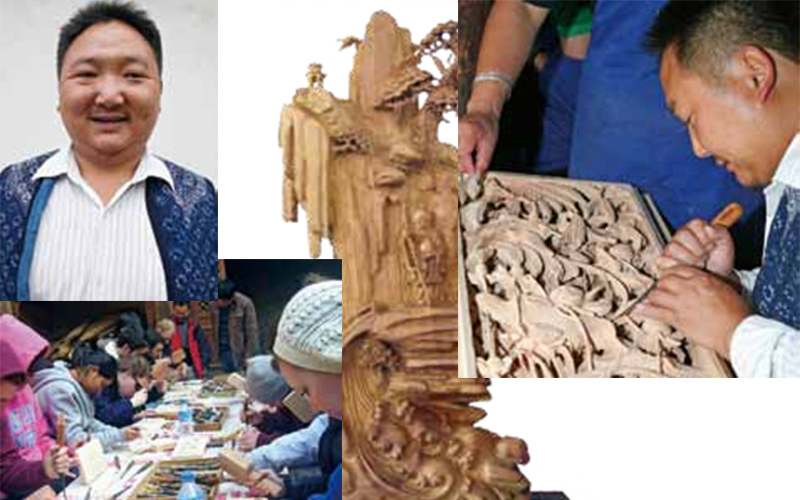
Zhang Qingchang, born in 1969 in Jinhua Town (金华镇), Jianchuan County (剑川县), Dali Bai Autonomous Prefecture (大理白族自治州), Yunnan Province (云南省), is a provincial-level representative inheritor of intangible cultural heritage. He has dedicated his life to the preservation and innovation of Jianchuan woodcarving (剑川木雕), one of China’s most renowned traditional crafts.
? Heritage and Artistic Style
As a member of the Bai (白族) ethnic group, Zhang Qingchang showed an early love for painting. He studied in the Ethnic Art Program of a vocational school, where he built a solid foundation in fine arts. After graduation, he joined the Jianchuan Ethnic Woodware Factory (剑川县民族木器厂) and apprenticed under several woodcarving masters, including Duan Guoliang (段国梁), Zhang Jinxing (张金星), and Yin Dequan (尹德全). His family itself has a woodworking tradition, making him the third generation in this craft.
Through decades of practice, he has created hundreds of new works featuring human figures, animals, and traditional stories. Representative works such as “Happiness, Wealth, Longevity, and Joy (福禄寿喜)” and various carved lattice doors are known for their:
He emphasizes a rigorous process—from design and rough carving to fine carving, polishing, and finishing—believing that strong artistic training is essential for transforming two-dimensional concepts into three-dimensional woodcarved works.
?️ Major Achievements and Representative Works
Zhang Qingchang’s artistry extends far beyond personal creations. His works have been commissioned for many landmark sites and institutions, including:
-
Lijiang’s Mu Mansion (丽江木府)
-
Kunming World Expo Garden “Herbal Medicine Garden” (昆明世博园“药草园”)
-
Guandu Ancient Town (官渡古镇)
-
Qiongzhu Temple (筇竹寺)
-
Daguan Pavilion Long Corridor (大观楼长廊)
-
Provincial Government and People’s Congress buildings in Yunnan
These works serve as cultural showcases of Jianchuan woodcarving to visitors from across China and beyond.
? Teaching and Passing Down the Craft
From 1995 to 1998, Zhang Qingchang opened a woodcarving training program in his own factory, personally instructing over 300 students. This initiative greatly contributed to the preservation and spread of Jianchuan woodcarving skills, cultivating a new generation of artisans.
? Industry Background and Contemporary Development
Jianchuan woodcarving has a history dating back to the late Neolithic Age, matured during the Han and Tang dynasties, and reached its artistic peak in the Ming and Qing dynasties. It is best known for relief carving, hollow carving, and especially masterful openwork carving (透雕). The craft was officially inscribed into the National Intangible Cultural Heritage List in 2011.
In recent years, Jianchuan has actively explored the integration of “Intangible Heritage + Cultural Tourism” by establishing heritage learning centers, master studios, and traditional craft lecture halls. According to 2025 data:
-
Over 26,000 people in Jianchuan are engaged in traditional crafts
-
The industry generates an annual output value of 5.6 billion RMB
-
Intangible heritage has become a key driver of local economic growth and rural revitalization
Zhang Qingchang continues the legacy of his teachers, including Duan Guoliang (段国梁) and his son Duan Sixing (段四兴, National-level Representative Inheritor), ensuring that Jianchuan woodcarving remains a living and evolving art form.
✨ Conclusion
Zhang Qingchang stands as both a guardian and innovator of Jianchuan (剑川) woodcarving. His artistry, teaching, and contributions to cultural industry development highlight the enduring brilliance of this thousand-year-old craft. For visitors to Yunnan, Jianchuan woodcarving offers not only exquisite artistry but also a window into the cultural depth of the Bai (白族) people.