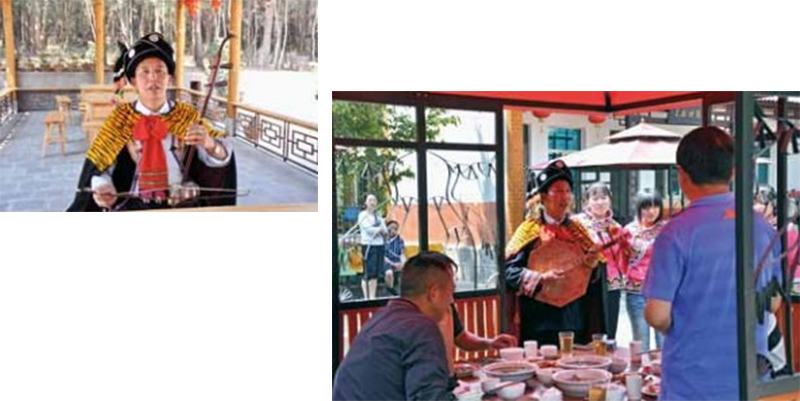
Yu Xueguang - Representative Inheritor of  Yi Folk Song (Toasting Song) Project in Wuding County, Chuxiong 

Yu Xueguang - Representative Inheritor of  Yi Folk Song (Toasting Song) Project in Wuding County, Chuxiong 

Yu Xueguang (born July 15, 1956) is the official representative inheritor of the national intangible cultural heritage project — Yi Ethnic Folk Songs (Yi Wine Songs). He comes from Dayongxi Village (大永西村), Shanpin Village Committee (山品村委会), Fawo Township (发窝乡), Wuding County (武定县), Chuxiong Yi Autonomous Prefecture (楚雄彝族自治州), Yunnan Province (云南省).

His artistic journey spans the critical transformation of this ancient singing tradition — from the brink of extinction to systematic protection. For over 70 years, through both preservation and innovation, he has brought Yi Wine Songs from remote mountain villages to national cultural stages, earning the title:
“Guardian Spirit of Songs in the Wumeng Mountains (乌蒙山中的歌魂守护者).”

Family Heritage & Early Training

Yu was born into a family of Yi Wine Song singers. Since childhood, he was immersed in the “A Shaoke” (阿勺克, Yi ritual wine songs) performed in weddings and village ceremonies.

After primary school, he apprenticed under Li Tianfu (李天富), a senior folk artist, where he systematically studied the entire repertoire of wine songs and their ritual procedures.

By age 20, Yu had already mastered 36 core pieces such as “Song for the Bride Leaving Home” (出嫁调) and “Welcoming the Guest Song” (迎客调), along with supporting dances like “Bell Dance” (铃铛舞) and “Mu Shu Shu” (木纾殳).

His voice is both powerful and soulful, blending the solemn chanting of Yi shamans (Bimo 毕摩) with the agility of mountain folk songs. In 1981, he organized a Yi Wine Song troupe in Kuixiang Township (奎香乡) and won second prize at the Zhaotong Regional Minority Arts Festival (昭通地区少数民族文艺汇演), marking the start of his professional career.

Core Skills & Cultural Preservation

A Living Standard of Ancient Songs

Yu preserves the entire ritual system of Yi Wine Songs, strictly following the nine ceremonial steps — Inviting Spirits, Purification, Antiphonal Singing, Sending Spirits, etc.

  • Authenticity of Repertoire: He has safeguarded fragments of Yi epics such as “Ashidi’s Genealogy” (阿细的先基) and “Meige” (梅葛).

  • Unique Performance Style: His innovations in throat-singing harmonies and triple-meter variations have been documented in The Anthology of Chinese Folk Songs – Yunnan Volume (中国民间歌曲集成·云南卷) as standard models.

Rescuing an Endangered Tradition

At one point, only a few elders still knew these songs. Yu led a revival project that included:

  • Fieldwork: Walking across Yiliang County (彝良县) and neighboring Yi villages, he collected 15 endangered melodies and recorded 60+ hours of original audio.

  • Community Training: He created “Wine Song Night Schools” around firepits, training new inheritors through oral teaching and body memory. As a result, the number of practitioners in Kuixiang Township grew from fewer than 10 to over 150.

Building a Transmission Network

Yu established a three-level inheritance system:

  • Family Transmission: His son Wang Yinhua (王银华) is now the fifth-generation inheritor.

  • Ritual Practice: Each year, Yu leads performances at the Torch Festival (火把节) and Yi New Year in October (十月年).

  • Community Training: He founded the Wang Xuecheng Wine Song Training Center (王学成酒礼歌传习所), where 20+ apprentices have been trained. His student Chen Min (陈敏) can already lead major performances such as “Songs of Celebration” (群歌欢腾).

Cultural Outreach & Modern Innovation

Cultural Ambassador on National Platforms

  • In 2018, Yu was recognized as a National Representative Inheritor of Intangible Cultural Heritage.

  • His performances have been featured on CCTV’s “Homeland China” (乡土中国), while his teaching clips on Douyin (TikTok China) have gained over 1 million views.

  • In 2019, his troupe’s production “Soul of Yi Wine” (乌蒙酒魂) won the Bronze “Caiyun Award” (彩云奖).

Tourism & Cultural Integration

  • Festivals: Yu organizes the Kuixiang Wine Song Cultural Festival (奎香酒礼歌文化节) during the Torch Festival, with live-stream audiences of 300,000+.

  • Tourism Experiences: At Xiaocaoba Scenic Area (小草坝景区), he designed an immersive Wine Song Center, where tourists can join in singing, dress in Yi costumes, and rehearse short performances — attracting 10,000+ participants annually.

Intangible Heritage Protection & Policy Support

  • Digital Archives: In collaboration with Yunnan Minzu University (云南民族大学), Yu recorded high-precision 3D motion files of 20 core dance movements and developed a VR teaching system launched on Xuexi Qiangguo (学习强国) platform.

  • Revival of Lost Works: He reconstructed traditional dramas such as “Dou Yi Passing the Exam” (窦仪下科) and “Burning the Mill” (火烧磨房), using modern stage lighting and design.

  • Policy & Funding: Provincial heritage funds helped build training centers, provide recording equipment, and subsidize young apprentices.

Challenges & Innovative Solutions

Despite his achievements, Yu faces:

  • Generational Gaps: Few young people (under 30) are willing to invest 10–15 years to master these songs.

  • Market Limitations: High-level ritual performances are niche, while cultural products bring little profit.

His solutions include:

  1. Digital Empowerment: Partnering with Huawei’s Digital Intangible Heritage Project, his VR teaching videos reached 1.5 million views.

  2. Music Fusion: Released the album “New Voices of Yi Wine” (酒韵新声), where the track “Fireside Night Talk” (火塘夜话) gained 3 million plays on Douyin.

  3. School Programs: Introduced Wine Song courses at Kuixiang Township Central Primary School (奎香乡中心小学), engaging 120+ young learners through games and performances.

Cultural Value & Modern Significance

Yu’s lifelong work embodies three key values:

  1. Historical Research: His preserved songs and rituals serve as living samples for studying Yi society and ancient religion in Northeast Yunnan.

  2. Cultural Identity & Unity: His troupe includes members of Yi, Han, and Miao ethnicities, strengthening community bonds.

  3. Educational Innovation: His model of combining traditional arts with modern education has been promoted across all 16 prefectures in Yunnan Province.

As Yu Xueguang himself says:

“Wine Songs are not just antiphonal singing — they are the cultural DNA carved into the bones of the Yi people.”

Through a lifetime of dedication, he has carried Yi Wine Songs from remote mountains to national and international stages, leaving a living testament to the richness of Chinese civilization’s diversity in unity.

Related Categories