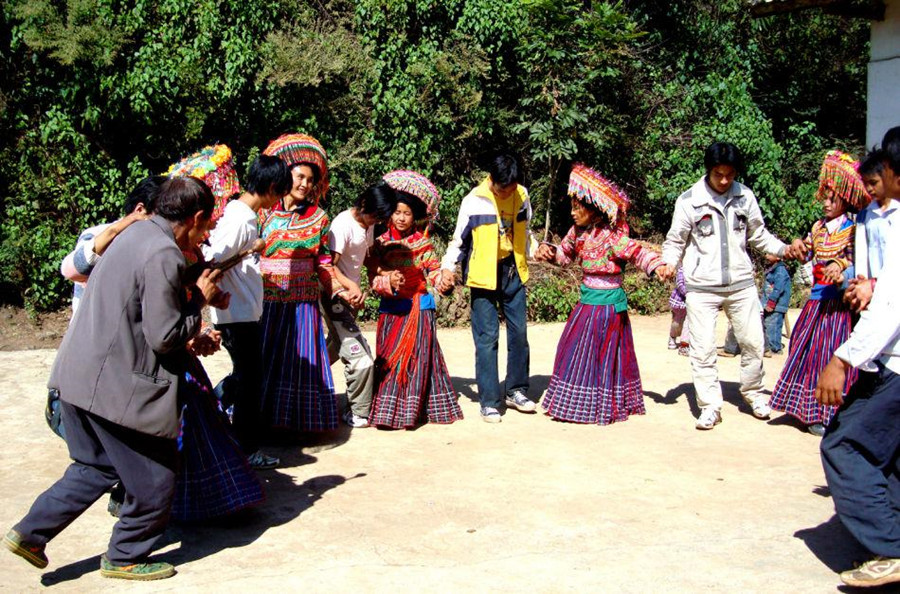
The Lisu Ethnic Group Gua Ke Dance (刮克舞), also known as Turning Dance (打转舞) or Joyful Dance (欢乐跳), is a traditional collective dance of the Lisu people in Fugong County (福贡县) and Lushui City (泸水市), Nujiang Lisu Autonomous Prefecture (怒江傈僳族自治州), Yunnan Province. Among them, the Gua Ke Dance of Lushui City is based on the "Production Dance," and in 2006 it was included in the first batch of Yunnan Provincial Intangible Cultural Heritage.
The dance originated from the legend that the ancestors of the Lisu people created it to drive away a rat spirit. It has two main forms: Qiben Gua Ke (期奔刮克), led by a dancer playing the qiben (其奔, a pipa-like instrument) or dilitu (笛哩图), and Tita Gua Ke (踢踏刮克), which uses stamping feet to create rhythm.
There are over 70 routines, including Twisting Dance, Hunting Dance, and Rice-Planting Dance, with movements such as foot stamping, turning, and spinning. It is usually performed around fireplaces or in village squares during festivals and weddings.
Provincial inheritor Wubosan (五波三) promotes the transmission of the dance through teaching by the fireplace, while Lushui City promotes it through cultural activities and the "Dancing Nujiang" competition.
Chinese Name: Lisu Ethnic Group Gua Ke Dance (傈僳族刮克舞)
Alias: Turning Dance (打转舞)
Meaning: Joyful Dance (欢乐跳)

Forms of Gua Ke
“Gua Ke” can be divided into Qiben Gua Ke (其本刮克) and Unaccompanied Tita Gua Ke (无伴奏踢踏刮克).
-
Qiben Gua Ke is accompanied by the qiben (其奔), a pipa-like instrument.
-
Unaccompanied Tita Gua Ke relies on stomping and scraping dance steps on the ground to create rhythm.
Pipa Dance (琵琶舞)
The Pipa Dance (琵琶舞), a form of entertainment, is the most beloved dance during festivals and weddings. As soon as the stringed instrument Xianzi (弦子) begins to play, people of all ages—from children to elders—start dancing.
Under the lead of the Xianzi player, participants dance in circles. The dance includes mimicking production and daily life, as well as expressive, lyrical movements. At weddings, a paired dance called “Qianwuqian (牵吾牵)” is also performed, where male dancers holding the Lisu pipa (琵琶) and female dancers playing the bili (筚篥) or bamboo flute lead participants in swaying their waists and skirts gracefully.
Tiao Jia (跳戛)
Tiao Jia (跳戛) is a collective song-and-dance performance. Traditionally, once it started, it could last several days, or at least one night. It was usually performed in houses or courtyards around a fireplace, accompanied by homemade wine, with participants singing and dancing together. The performance ended with the dancers singing in a high octave.
There are many variations of Tiao Jia, including New Year Jia (过年嘎), Engagement Jia (订亲戛), Wedding Jia (结婚戛), Visiting Jia (串亲访友戛), Mountain-Cutting Jia (砍山戛), Planting Jia (裁种戛), Birthday Jia (做生日戛), Family-Division Jia (分家戛), Funeral Jia (丧事戛), and Harvest Celebration Jia (闹丰收戛).
During the traditional Knife-Pole Festival (刀杆节), Tiao Jia is also performed before climbing the knife pole or walking through fire. Though the lyrics differ, the melody remains largely consistent, and the dance movements are similar.
Guozhuang Dance (锅庄舞)
The Guozhuang Dance (锅庄舞) is a popular dance among both the Yi (彝族) and Lisu (傈僳族) ethnic groups. The name "Guozhuang" comes from its origins of being performed around a fireplace.
In Yunnan, these two ethnic groups are particularly known for their distinctive style of Guozhuang. It is performed during festivals, without limits on the number of participants, and does not require instrumental accompaniment.