Overview
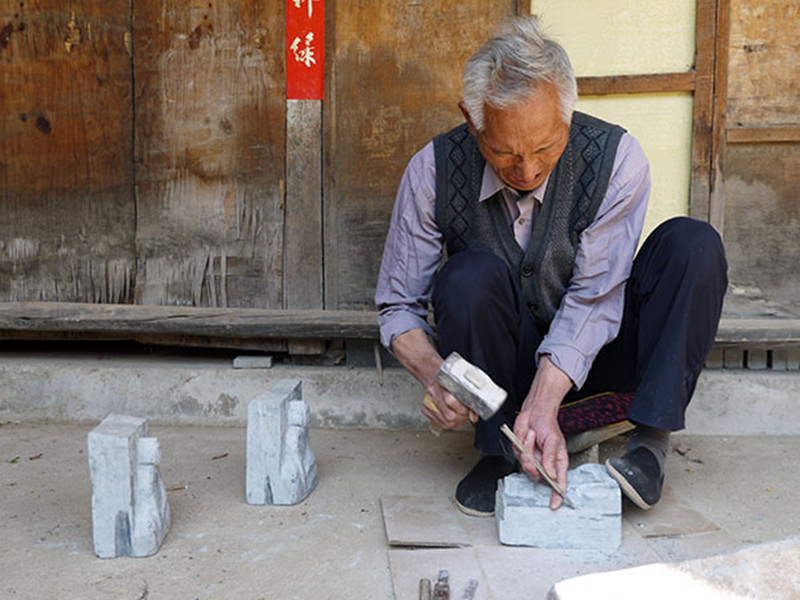
Duan Zhenran (段臻然, b. 1948), a Bai ethnic artisan from Qifeng Village, Fengyu Township, Eryuan County, Dali Prefecture, Yunnan Province, is the 7th-generation inheritor of Fengyu Inkstone making and a provincial-level representative inheritor of intangible cultural heritage. Beginning his apprenticeship at age 13 under his father Duan Hanbing, he was able to carve independently by 16 and has now dedicated over 50 years to the craft. Renowned for both his adherence to tradition and bold innovations, he is the creator of monumental works such as the “Nine Dragons Giant Inkstone” and the “Millennium Inkstone”. In 2001, he was awarded the title of “Master of Folk Arts and Crafts of Dali Prefecture” and formally recognized as a provincial intangible heritage inheritor, cementing his role as a key figure in the preservation and revitalization of Fengyu Inkstone culture.
Personal Background
-
Name: Duan Zhenran (段臻然)
-
Ethnicity: Bai
-
Birth: 1948, Fengyu Township, Eryuan County, Dali Prefecture, Yunnan
-
Family Heritage: 7th-generation inheritor; the Duan family has made inkstones since the Ming and Qing dynasties
-
Titles & Honors:
-
Provincial Representative Inheritor of Intangible Cultural Heritage
-
Dali Prefecture Folk Arts and Crafts Master (2001)
-
Founder of Fengyan Handicraft Factory (1997)
Growing up in Fengyu, a national-level historical and cultural town steeped in Confucian and scholarly traditions, Duan was immersed in an environment of “ink and brush culture” that naturally fostered his passion for inkstone carving.
Apprenticeship and Artistic Development
-
Initiation (13–16 years old):
Learned inkstone selection, cutting, and polishing from his father Duan Hanbing. Mastered basic skills by 16.
-
Skill Refinement (Youth to Adulthood):
Through practice and observation, he perfected all processes, with particular emphasis on working according to the stone’s natural grain and pattern.
-
Innovation (Adulthood):
Broke away from traditional rectangular or circular designs, experimenting with 3D and irregular forms, integrating modern aesthetics into classical inkstone art.
-
Industrial Development (1997–present):
Founded Fengyan Handicraft Factory, combining traditional craftsmanship with modern production, training dozens of apprentices and ensuring sustainable transmission.
Artistic Features and Style
| Aspect |
Characteristics |
Artistic Value |
| Stone Selection |
Chooses fine-grained stones from the northern slope of Bird-hanging Mountain |
Delicate texture, lustrous finish; compared to “Shoushan” and “Tianhuang” stones |
| Crafting Principle |
因材施艺 (adapting design to stone’s natural qualities) |
Shapes highlight natural veins, enhancing uniqueness |
| Carving Technique |
“One cut precise, two cuts firm, three cuts balanced, four cuts refined” |
Produces fine, flowing lines and vivid reliefs |
| Stylistic Innovation |
Merges floral, animal, landscape, architectural, and mythological motifs |
Bridges tradition with modern aesthetics |
| Functional & Artistic Value |
Inkstones are practical tools and collectible artworks |
Embody both cultural symbolism and craftsmanship |
Representative Works
1. Nine Dragons Giant Inkstone (1999)
-
Created for the 1999 Kunming World Horticultural Exposition.
-
Features nine intricately carved dragons, each with distinct poses and expressions.
-
Donated by Eryuan County to the Expo; permanently displayed in the China Pavilion, Kunming Expo Garden.
-
Significance: Landmark achievement, symbolizing Fengyu Inkstone’s entry onto the world stage.
2. Millennium Inkstone (2000)
-
Designed by Duan, executed by his eldest son, Duan Zhiming.
-
Collected by the Yunnan Nationalities Museum.
-
Combines traditional motifs with millennial symbolism, blending heritage with contemporary creativity.
3. Other Works
-
“Rising Sun Dragon Inkstone”: features a sun motif in yellow-veined stone, symbolizing renewal.
-
“Cabbage Inkstone”: uses natural green-black stone hues to mimic a cabbage form.
-
“Borrowing Light Inkstone”: cleverly employs natural color bands to represent beams of light.
-
“Two Dragons Contending for a Pearl”: lively 3D sculpture.
-
“Dragon and Phoenix Prosperity”: auspicious motifs symbolizing harmony.
Transmission and Legacy
-
Apprentice Training
-
Founded Fengyan Handicraft Factory (1997).
-
Trained over 40 apprentices in 15 years; 12 fully mastered the craft.
-
Example: Li Shaoxue from Honghe Prefecture, now a well-regarded successor.
-
Family Succession
-
Passed techniques to his eldest son, Duan Zhiming (b. 1972, art academy graduate, 1994).
-
Duan Zhiming continues to expand styles, developing 100+ inkstone models of artistic and collectible value.
-
Clear lineage: Duan Hanbing (6th gen) → Duan Zhenran (7th gen) → Duan Zhiming (8th gen).
-
Cultural Promotion
-
Advocates “intangible heritage + industry + tourism” development model.
-
Works exhibited nationally and internationally, earning acclaim from collectors and calligraphers.
Fengyu Inkstone: Cultural Background
1. Historical Origins
-
First carved in late Yuan–early Ming (400+ years ago).
-
Legend: Yang Bideng of Fengyu discovered inkstone stone during the Shunzhi era (Qing), presenting it as tribute.
-
By Kangxi’s reign, Fengyu Inkstones were widely used in Beijing, favored by literati.
2. Cultural Value
-
Practical Function: Produces smooth, glossy ink, retains moisture, resists corrosion.
-
Scholarly Symbol: Once listed by China Painting & Calligraphy Daily as comparable to China’s “Four Famous Inkstones.”
-
Regional Identity: Represents Fengyu’s cultural brand, alongside temple music and folk opera.
3. Contemporary Protection
-
Heritage System: In 2018, a Fengyu Inkstone Craft Heritage Studio was established.
-
Inheritor Lineage: Provincial inheritor (Duan Zhenran) → Prefectural inheritor (Zhang Yuetang) → County inheritor (Duan Zhiming).
-
Innovation: Development of portable palm-sized inkstones for modern users.
-
Integration: Promoted under “heritage + tourism” and “heritage + rural revitalization”.
Conclusion
Duan Zhenran exemplifies the role of a living bridge between past and present. Through half a century of dedication, he has elevated Fengyu Inkstone from a local craft into a cultural emblem with international recognition. His contributions—artistic innovation, apprentice training, family succession, and cultural promotion—ensure that this centuries-old art not only survives but thrives in the modern era.