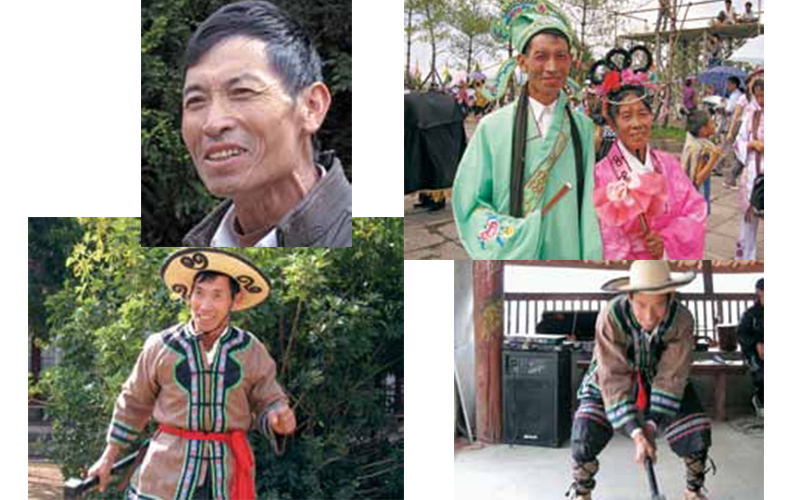
Zhao Pengyun (1950– ) is a provincial-level representative inheritor of Chui Chui Qiang (吹吹腔), a traditional Bai ethnic opera from Xiabu Village (下坞村), Jiuzhou Town (旧州镇), Yunlong County (云龙县), Dali Bai Autonomous Prefecture (大理白族自治州), Yunnan Province (云南省). His artistic career spans the critical period when Chui Chui Qiang transitioned from traditional to modern forms. Over more than 70 years of dedication and innovation, he has brought this “epic carved in the sound of gongs and drums” from rural stages to national platforms, earning him the title: “Living Guardian of Southern-Style Chui Chui Qiang.”
I. Family Heritage and Early Training
Born into a theatrical family in Xiabu Village (下坞村), Zhao Pengyun began learning the fundamentals of Chui Chui Qiang at age five under his father. At eight, he performed Honghu Water Waves (《洪湖水浪打浪》), and by twelve, he had become a student of Li Chunfang (李春芳), a master of Yunlong Chui Chui Qiang.
He systematically mastered the four role categories—Sheng (生, male), Dan (旦, female), Jing (净, painted-face), and Chou (丑, clown). Zhao became renowned for his unique stepping technique (synchronized with the suona’s melody) and his use of the Sanqi Yiwushan Hua poetic form (三七一五山花体, three 7-character lines followed by one 5-character line).
His representative work, Dou Yi Passes the Imperial Exam (《窦仪下科》), vividly portrays the Bai intellectual ideal of perseverance, public service, and moral integrity. This piece was later included in the Encyclopedia of Chinese Opera (《中国戏曲志》).
II. Core Skills and Artistic Innovations
1. Preserver of Traditional Arts
Zhao inherited the full repertoire of nine rhythms and thirteen tunes of Chui Chui Qiang. He excelled in one-word improvisational singing and starred in classics such as Cui Wenrui Chops Firewood (《崔文瑞砍柴》) and The Burning Mill (《火烧磨房》).
Through clever alternation between dry singing (徒唱) and suona-drum interludes, he demonstrated the Bai opera rhythm of “blowing, singing, and drumming.”
His expertise also extends to facial makeup techniques (using natural pigments like soot and cinnabar) and rituals to honor theater deities (worship before performances and “Golden Roll rituals” after). Experts regard these practices as living specimens of Bai indigenous religion.
2. Innovator of Modern Performances
To address the aging audience of traditional opera, Zhao created over 50 modern plays, including Trials of Fortune (《好事多磨》) and Conscience Is Capital (《良心是本钱》).
-
Trials of Fortune uses the themes of family disputes, mediation through village customs, and harmonious coexistence—blending Bai Benzhu culture (本主文化) with socialist values.
-
His innovations were incorporated into local village regulations and featured in the magazine Yunlong Culture (《云龙文化》).
-
In Close Neighbors Are Better than Distant Relatives (《远亲不及近邻》), he integrated Bai folk melodies with electronic sound effects, breathing modern vitality into the ancient art form.
III. Transmission and Social Contributions
1. Building a Talent Pipeline
Zhao established a multi-layered training system:
-
Family Apprenticeship: His son Zhao Zhiyuan (赵志远) became a key actor specializing in martial roles.
-
School Programs: Partnered with Gongguoqiao Town Primary School (功果桥镇中心小学), he transformed plays such as Wamula (《挖木拉》) into classroom exercises, training over 200 young inheritors.
-
Community Training: At his own Chui Chui Qiang Inheritance Workshop (吹吹腔传习所), he passed down body movements and drum rhythms to 30+ disciples, with 5 achieving county-level inheritor status.
2. Cultural Promotion and International Exchange
-
National Recognition: In 2004, Zhao led a troupe to the Fifth Chinese Opera Festival, where Dou Yi Passes the Imperial Exam (《窦仪下科》) won the Best Traditional Opera Award. In 2014, he was featured in CCTV’s Homeland (《乡土》) documentary on Yunlong Chui Chui Qiang.
-
Cross-Border Exchange: In 2019, he performed The Bamboo Grove Boy (《竹林拾子》) in Mandalay, Myanmar, strengthening cultural ties between China and Myanmar.
3. Tourism Integration and Economic Impact
-
Cultural Tourism: Designed immersive programs for the Bai Opera Museum (白族吹吹腔文化艺术博物馆) in Yunlong County, attracting over 50,000 visitors annually and boosting villagers’ income.
-
Cultural Products: Collaborated with handicraft workshops to launch over 20 heritage-inspired products, with Sheng-Dan-Jing-Chou bookmarks (生旦净丑书签) becoming a bestseller for three consecutive years.
IV. Safeguarding Heritage with Modern Technology
1. Systematic Preservation
-
Documentation: Compiled The Anthology of Traditional Bai Opera from Yunlong (《云龙白族吹吹腔传统剧目汇编》), archiving 120 plays.
-
Digital Archives: Applied 3D scanning to preserve face-painting designs and costumes, creating high-precision digital records.
2. Policy and Technology Support
-
Secured 120,000 RMB in national heritage protection funding for equipment and apprentice subsidies.
-
Partnered with Huawei’s “Digital Intangible Heritage” project, launching a VR learning system for Chui Chui Qiang. On the “Learning Power” (学习强国) platform, it gained over 2 million views, attracting younger audiences.
V. Cultural Value and Legacy
Zhao Pengyun’s contributions carry threefold significance:
-
Historical Value: His preserved drum scores and rituals provide evidence of how Yiyang Opera (弋阳腔, Ming dynasty) evolved in Southwest China.
-
Artistic Value: By fusing Bai Shanhua poetry (山花体) with opera, he pioneered a “poetry-opera synthesis,” highlighted in the History of Ethnic Minority Theater in China (《中国少数民族戏剧史》).
-
Social Value: His troupe includes Bai, Han, and Lisu members, fostering inter-ethnic unity in Yunlong County. It has been recognized as a “Model Team for Ethnic Unity in Yunnan Province.”
As Zhao himself declares:
“Chui Chui Qiang is not just the sound of gongs and drums—it is the cultural gene of the Bai people, guarded with our lives.”
Amid digital transformation, Zhao Pengyun continues to safeguard and reinvent this thousand-year-old art form, ensuring it thrives as a vibrant chapter in the diverse fabric of Chinese civilization.