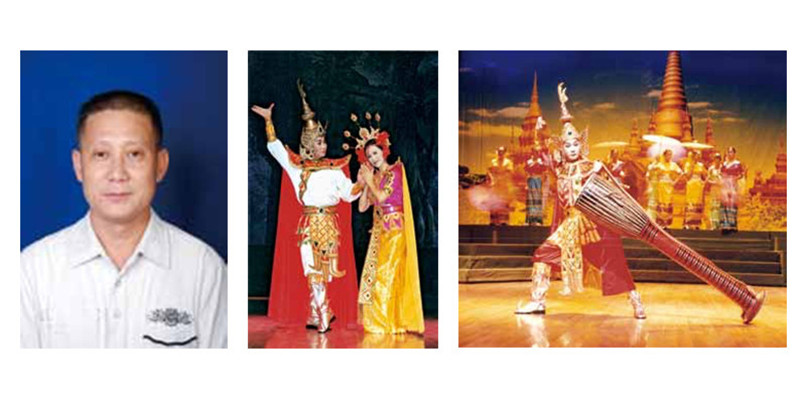
Jin Bao (also written as Jin Bao/金保, 1961– ) is a provincial-level representative inheritor of Dai Opera (傣剧) from Zhefang Town (遮放镇), Mangshi (芒市), Dehong Dai and Jingpo Autonomous Prefecture (德宏傣族景颇族自治州), Yunnan Province.
His artistic career coincides with the crucial transition of Dai Opera from tradition to modernity. With his exceptional stage performances, systematic teaching practices, and international cultural influence, he is widely known as the “Prince of Dai Opera.”
Early Life and Artistic Achievements
Born in Nongmen Village (弄门村), Zhefang Town (遮放镇), Jin Bao grew up in a farming family. At the age of 18, his talent was discovered by the Dehong Dai Opera Troupe (德宏州傣剧团). He studied under masters Fang Yulong (方余龙) and Dao Baoju (刀保钜), mastering the Sheng (生角) role techniques of Dai Opera.
-
Stage Achievements: Jin Bao’s representative works include Haihan (海罕), Langtuihan (朗推罕), and Nanxila (南西拉), where he often played the role of a Dai prince. His performance in Nanxila (南西拉) won the Gold Award at the First National Minority Drama Festival, along with the Outstanding Performance Award. He was also honored with the “Golden Peacock Award” for excellence in minority drama.
-
Performance Style: His art is praised for being “natural yet powerful,” combining ritual traditions with contemporary stage aesthetics.
Inheritance and Teaching System
Jin Bao established a three-dimensional inheritance model of professional troupe + schools + community.
Professional Training
As a core actor of the Dehong Dai Opera Heritage and Performance Center (德宏州傣剧传承保护展演中心), he has trained more than 10 key successors, 3 of whom have won prefecture-level championships.
School Programs
In partnership with Zhefang Town Central Primary School (遮放镇中心小学), he introduced Dai Opera courses, combining vocal training with stage performance. Over 200 young students have been trained, and the program was recognized as a “Yunnan Intangible Cultural Heritage in Schools” model.
Community Transmission
In his hometown Nongmen Village (弄门村), he established the Jin Bao Dai Opera Inheritance Center (金保傣剧传习所), where he applies the traditional “hearthside teaching” method. Nearly 1,000 amateur performers from Dehong (德宏) and even Shan State (掸邦) in Myanmar have been trained here.
Cultural Exchange and Global Influence
Jin Bao has played an important role in introducing Dai Opera to the world.
-
International Tours: In 1985, he performed Langtuihan (朗推罕) in Japan as part of the Chinese Minority Drama Delegation. In 2014, under the Ministry of Culture, he toured five European countries including Poland and the Czech Republic.
-
Recordings and Publications: In 1989, he released the Dai-language album Dehong – My Home (德宏—我的家) with Jin Xiaofeng (金小凤), which became widely popular among Dai communities in Southeast Asia. In 2013, he co-authored Dai Opera Teaching Manual (傣剧教程) in both Chinese and Dai.
-
Media Exposure: His performances have been featured in CCTV’s Chinese Opera Gala (中国戏曲大会) and Heritage in China (非遗里的中国). His teaching videos on Douyin (TikTok China) gained over a million views, inspiring even overseas learners.
Intangible Heritage Protection and Innovation
Jin Bao has actively participated in the systematic preservation of Dai Opera.
-
Restoration of Classic Plays: He led the revival of endangered works such as A Luan Xiang Meng (阿鸾相勐) and The Twelve Princesses’ Eyes (十二个王妃的眼睛). Using 3D scanning, he created digital archives of 108 vocal techniques and stage movements.
-
Cultural Tourism Integration: He designed immersive Dai Opera experiences at Mangshi’s Mengbanaxi Park (勐巴娜西珍奇园) and Ruili’s “One Village, Two Countries” Scenic Area (瑞丽一寨两国). These projects attract over 50,000 visitors annually, raising villagers’ income by an average of 1,500 yuan.
-
Policy Advocacy: As a member of the Dehong Prefecture CPPCC (德宏州政协), he promoted the Dai Opera Protection Regulations (傣剧保护条例) and secured 120,000 yuan in national heritage funds for recording equipment and training centers.
Artistic and Cultural Value
Jin Bao’s half-century dedication carries threefold significance:
-
Theatrical Value: His preservation of traditional vocal techniques and ritual codes provides a living archive for scholars studying the evolution of minority theater in China.
-
Cultural Identity: Along the China–Myanmar border, Dai Opera has become a shared cultural bond. Jin Bao’s troupe includes Dai, Jingpo (景颇), and Achang (阿昌) members, promoting cultural coexistence.
-
Educational Innovation: His teaching model of combining traditional skills with modern education is recognized by the Yunnan Provincial Department of Culture and Tourism as a model case for intangible heritage transmission.
As Jin Bao himself once said:
“Dai Opera is not just stage performance; it is the cultural DNA of the Dai people.”
Through balancing tradition and innovation, he has carried Dai Opera from the village hearth to the global stage, making it a vivid symbol of the unity and diversity of Chinese civilization.
l