Yunnan Guide
  • Yunnan Guide
  • Travel Tips
  • Tour Planing
  • Ethnic Culture
  • Yunnan Climate
  • Golf Courses
  • Travel Articles
  • Bulang' s Singing with Playing Stringed Instrument

    22/05/2019Crazy Jone6097 wordsAbout 21 minutes

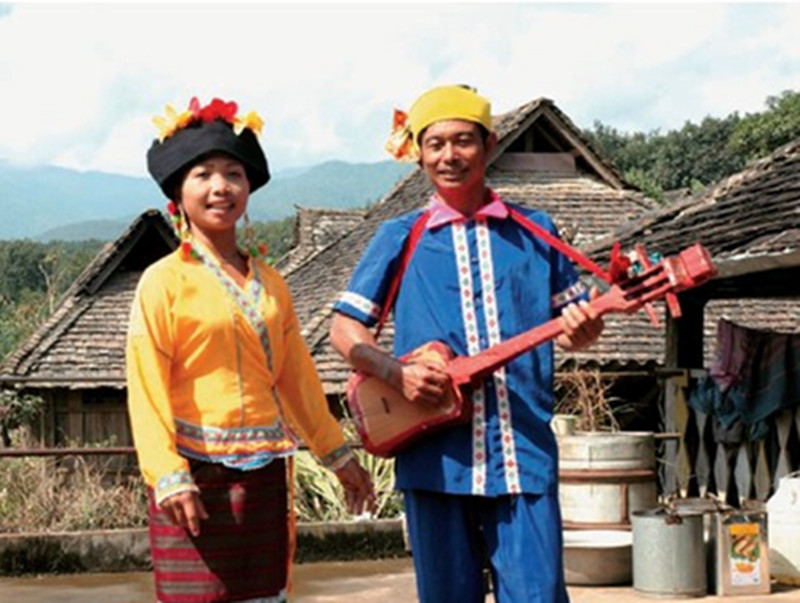
    Blang (布朗族) ballad singing, also known as Blang Folk Song with String Accompaniment (布朗族弹唱), is a traditional music form from Menghai County (勐海县), Yunnan (云南), recognized as a national intangible cultural heritage. Popular in Blang-inhabited areas such as Blangshan Township (布朗山乡), Xiding Township (西定乡), Daluo Town (打洛镇), and Mengman Town (勐满镇), it originated from the songs of Blang ancestors and incorporated influences from Dai (傣族) music. The form features five basic melodies: Suo (索), Shen (甚), Zhuai (拽), Zai (宰), and Tuanman (团曼). Typically performed as male-female duets, males sing while playing the four-stringed Blang Dêng (布朗玎), and females respond with corresponding lyrics. The melodies are smooth and delicate, with lyrics often expressing love and longing. Blang ballad singing is performed at major festivals, weddings, funerals, and other social occasions, covering themes such as migration history, production knowledge, religious rituals, folk songs, love songs, labor songs, and children’s songs.

    Heritage Level: National Intangible Cultural Heritage
    Heritage Number: Ⅱ-114
    Approval Date: June 7, 2008
    Region: Menghai County (勐海县), Yunnan (云南)
    Category: Traditional Music


    Historical Origins

    Blang ballad singing is mainly popular in Daluo Town (打洛镇), Blangshan Township (布朗山乡), Xiding Township (西定乡) in Menghai County (勐海县), and Huimin Hani Township (惠民哈尼族乡) in Lancang Lahu Autonomous County (澜沧拉祜族自治县), Pu’er (普洱市), as well as Blang communities across the border in Myanmar’s Shan State Fourth Special District. Over centuries, it has experienced several stages: early development, restriction during the Cultural Revolution, and revival under renewed national attention to ethnic culture.

    Before 1950: Dai Cultural Influence

    Before 1950, Blang ballad singing was heavily influenced by Dai (傣族) culture due to long-term rule by Dai local chiefs. Blang people had no written language, and Buddhist practices introduced Dai script, allowing cultural preservation and absorption. Many Blang songs were sung in Dai language, later adapted into Blang language. Villages influenced by Dai culture were known as “Dai Blang (傣布朗)”, communicating in Dai language while still performing Blang songs.

    1950–2000: Development, Decline, and Revival

    After 1949, with the end of the Dai chiefdom system, Blang villages established schools and gradually revived their own musical identity, replacing Dai language songs with Blang language performances. The Blang Dêng was added as an accompanying instrument. During this period, Blang ballad singing experienced:

    1. Pre-Cultural Revolution “Rescue” – From the 1950s to 1960s, national policies encouraged the preservation of ethnic music, leading to documentation and performance of Blang folk songs.
    2. Cultural Revolution “Silencing” – Between 1966–1976, religious and folk music were banned, halting traditional music performance.
    3. Post-Reform “Revival” – After China’s reform and opening, Blang ballad singing re-emerged as a performance art on stage.

    2000s Onwards: Flourishing Development

    Entering the 21st century, Blang ballad singing received government support through training programs, the establishment of practice centers, and recognition of Menghai Cultural Center (勐海县文化馆) as a protection unit for the heritage project.


    Basic Features

    Performance Form

    Blang ballad singing can be solo, duet, or group. Improvised singing is a key feature. Traditionally, it is a seated duet form with a young man playing the Blang Dêng while courting a young woman. Modern stage performances often use walking-style singing, with male performers singing and playing the instrument while dancing, and female performers singing and dancing.

    Musical Style

    The melodies derive from the Suo (索) tune, using a pentatonic scale with four modes: Guan, Zhi, Shang, and Yu. Melodies are lively, varied, and include octave leaps. The phrasing follows the lyrics rather than fixed measures, with interludes providing rest and enhancing expression. The style is cheerful, flexible, and rich in ethnic characteristics.

    Melody Types

    The main types are Zai (宰), Zhuai (拽), Suo (索), Sheng (笙), and Tongma (筒玛). Zai tunes often recount historical or ritual songs, Suo tunes are commonly used for love songs, Sheng tunes tell stories or daily life, and melodies vary by village. Examples include Manxi (曼夕调), Manya (曼芽调), Manshan (曼山调) in Daluo Town, and Daluo (打洛调), Xiding (西定调), Manmai (曼迈调), Blangshan (布朗山调) across Xishuangbanna (西双版纳).

    Lyrics

    Lyrics are primarily in Blang language, with some Dai, Wa, and Chinese words. They are structured in question-and-answer or conversational forms, often metaphorical, especially in love songs, comparing emotions to flowers, birds, or fish.

    Accompaniment Instrument

    The main instrument is the Blang Dêng (布朗玎), traditionally two-stringed, later adapted to four strings. It consists of a head, neck, and soundbox, carved from a single piece of wood, often Toona sinensis. Dimensions vary slightly by village, e.g., in Manxi Lower Village (曼夕下寨), total length is 96–97 cm, soundbox 31 cm, and fingerboard 39–39.5 cm.


    Representative Works

    Blang ballad singing covers diverse themes:

    • Zai Tune “Blang Migration Song (布朗族迁徙歌)” – Migration due to war.
    • Zai Wen “Lamuliao (拉木料)” – Unity in communal work.
    • Meli Meran Tune “Meeting the Yellow Ox (相遇黄牛)” – Childhood joy.
    • Suo Tune “Love Duet (情歌对唱)” – Young love and admiration.

    Modern works reflect social progress, e.g., “Joyful Blang (欢乐的布朗)”, “Two Flowers Equally Fragrant (两朵花儿一样香)”, and “Tonight the Moonlight is Beautiful (今夜月色多美好)”.


    Transmission and Protection

    Blang ballad singing is a vital part of Blang culture, expressing identity and facilitating cultural exchange. Preservation faces challenges due to external cultural influences and traditional restrictions on women performing publicly.

    Representative Inheritor:

    • Yan Waluo (岩瓦洛), born 1959, designated in 2009 as a national-level representative inheritor.

    Protection Measures:

    • Annual training at Menghai Cultural Center (勐海县文化馆) since 2008.
    • Practice centers established in Manya Village (曼芽村) in 2010 and at inheritor Yukanla’s home (玉坎拉家) in 2014.
    • Listed as a protected unit of national intangible cultural heritage in 2019 and 2023.

    Social Influence

    Major Performances:

    • 1965: “Changes in My Hometown” at Yunnan Province folk music event.
    • 2015: Performance at Beijing Music Festival.
    • 2019: “Sun Shines into My Heart” at China Original Folk Song Festival.

    Honors:

    • Early 1980s: “Joyful Blang” won Outstanding Program Award at the Chinese Minority Art Performance.


    Blang ballad singing (布朗族弹唱) embodies the cultural identity, musical creativity, and historical experiences of the Blang people in Menghai County (勐海县). From its roots in ancestral songs influenced by Dai culture to its revival and modernization, this art form preserves rich melodies, poetic lyrics, and traditional instrumental techniques. With government support, dedicated inheritors, and growing public interest, Blang ballad singing continues to thrive as a living tradition, connecting past and present while showcasing Blang cultural heritage to the wider world.


    ENQUIRY

    Have a question before booking? Message us to learn more.
    Click to change