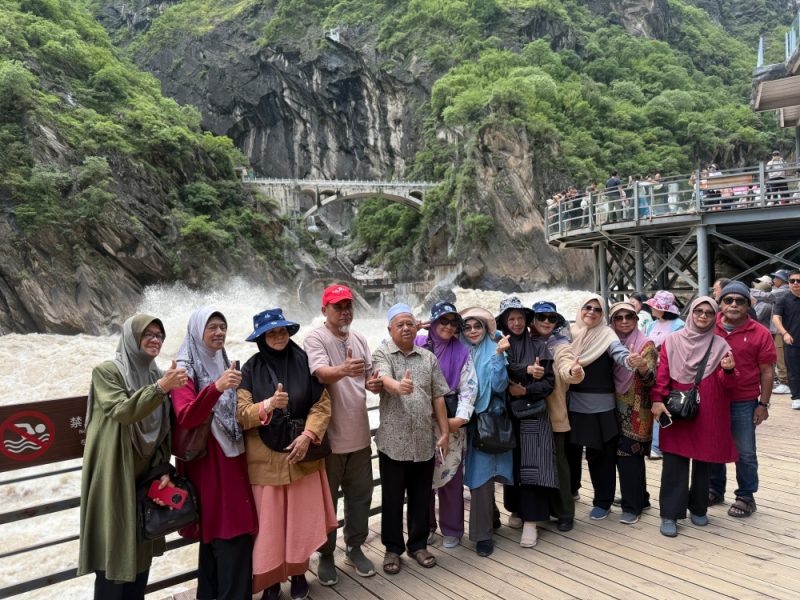
Tiger Leaping Gorge is one of the deepest and most spectacular river gorges in the world, located between Lijiang and Shangri-La in northwestern Yunnan. The journey from Tiger Leaping Gorge (虎跳峡) to Shangri-La (香格里拉) is approximately 100 kilometers from Qiaotou Town, with the road following National Highway G214, an important section of the Yunnan–Tibet route.
For travelers starting from Middle Tiger Leaping Gorge, the journey is somewhat longer because they first need to travel along mountain roads from the scenic area to Qiaotou. Travelers can choose between tourist shuttle buses, regular buses, private cars, motorcycles and bicycles depending on their time, budget and physical condition.
Tiger Leaping Gorge to Shangri-La Transportation Overview
The two most important departure points are Qiaotou Town (桥头镇), also known as Tiger Leaping Gorge Town, and Tina's Guesthouse (中峡客栈) in Middle Tiger Leaping Gorge. They are different locations and have different transportation options.
| Transportation |
Starting Point |
Approx. Distance |
Typical Travel Time |
Recommended For |
| Regular Bus |
Qiaotou |
About 100 km |
About 2 hours |
Budget travelers |
| Tourist Shuttle |
Tina's Guesthouse |
About 100+ km |
Several hours |
Hikers |
| Private Car |
Qiaotou / Middle Gorge |
About 100–120 km |
About 2–3 hours |
Families and groups |
| Motorcycle |
Qiaotou |
About 100 km |
About 2.5–3 hours |
Experienced riders |
| Bicycle |
Qiaotou |
About 100 km |
About 8–10 hours |
Experienced cyclists |
The exact distance and travel time vary according to the departure point, road conditions, traffic and weather.
1. Travel from Tiger Leaping Gorge to Shangri-La by Bus
Qiaotou to Shangri-La by Regular Bus
Travelers staying around Qiaotou can usually wait along G214 for passenger buses traveling from Lijiang toward Shangri-La. Qiaotou is an important transportation point between Lijiang and Shangri-La, so buses pass through during the daytime.
The journey from Qiaotou to Shangri-La is approximately 100 kilometers and normally takes around 2 hours, depending on traffic and road conditions. The usual destination is Shangri-La Bus Station (香格里拉客运站).
The main advantage of taking a regular bus is that there are generally more departures than tourist shuttles, making it convenient for independent travelers. However, buses can become crowded during weekends, public holidays and peak tourist seasons, and roadside boarding may not guarantee a particular seat.
Middle Tiger Leaping Gorge to Shangri-La Tourist Shuttle
For travelers completing the high trail or other hiking routes through Middle Tiger Leaping Gorge, the tourist shuttle from Tina's Guesthouse is one of the most convenient choices.
A shared tourist vehicle normally departs from Tina's Guesthouse (中峡客栈) in the afternoon and travels directly toward Shangri-La. The service is particularly useful for hikers who do not want to return to Qiaotou before continuing their journey.
Seats can become limited during the busy season, so advance reservation is recommended. Tina's Guesthouse can also provide luggage storage for travelers carrying large backpacks or suitcases.
The usual drop-off area is around Dukezong Ancient Town (独克宗古城), making it convenient for travelers staying in the historic center of Shangri-La.
2. Traveling from Tiger Leaping Gorge to Shangri-La by Train
There is no direct train from Tiger Leaping Gorge to Shangri-La.
Travelers who specifically want to use the railway would first need to travel to Lijiang Railway Station and then take a train from Lijiang to Shangri-La Railway Station. This requires backtracking and multiple transfers, making it considerably less efficient than traveling directly by road.
For most visitors, a bus, private car or shared vehicle is a much more practical option.
The railway becomes more useful when travelers are planning a larger itinerary connecting Lijiang, Shangri-La and other cities in Yunnan rather than simply traveling from Tiger Leaping Gorge to Shangri-La.
3. Tiger Leaping Gorge to Shangri-La by Private Car
A private car or chartered vehicle is one of the most comfortable ways to travel from Tiger Leaping Gorge to Shangri-La.
From Qiaotou, the route generally follows G214 toward Shangri-La. Travelers starting from Middle Tiger Leaping Gorge first need to travel out of the gorge area and connect with the main road near Qiaotou.
A private transfer normally takes around 2–3 hours depending on the exact starting point, road conditions and stops. The main advantage is flexibility: travelers can stop at viewpoints, villages and scenic sections along the way rather than following a fixed bus schedule.
This option is particularly suitable for families, small groups, travelers carrying large luggage, photographers and visitors who want to combine Tiger Leaping Gorge with a sightseeing journey to Shangri-La.
For customized Yunnan tours, Yaso Trip can arrange private vehicles and experienced local drivers for the Tiger Leaping Gorge–Shangri-La route, including customized stops and onward transportation.
4. Tiger Leaping Gorge to Shangri-La by Motorcycle
Motorcycle riding from Tiger Leaping Gorge to Shangri-La is an attractive option for experienced riders who want to experience the changing landscapes of northwestern Yunnan.
The main route is:
Qiaotou – G214 – Shangri-La
The distance from Qiaotou to Shangri-La is approximately 100 kilometers, and continuous riding generally takes around 2.5–3 hours. Riders starting from Middle Tiger Leaping Gorge need to first use local mountain roads to reach Qiaotou before joining G214.
Road Conditions for Motorcycle Riding
Most of the main route is paved, but the road includes numerous curves and long uphill sections. The elevation rises substantially from the lower valley around Tiger Leaping Gorge toward Shangri-La, reaching approximately 3,300 meters above sea level.
The combination of climbing, curves, heavy vehicles and changing weather requires careful riding. Large trucks are common on parts of G214, while mountain sections can have limited visibility around bends.
During the rainy season, especially from June to September, rain can increase the risk of falling rocks, muddy sections and localized road damage.
Motorcycle riders should wear a full set of protective equipment, including a helmet, riding jacket, gloves and appropriate footwear. Fuel should also be topped up before entering longer mountain sections.
5. Tiger Leaping Gorge to Shangri-La by Bicycle
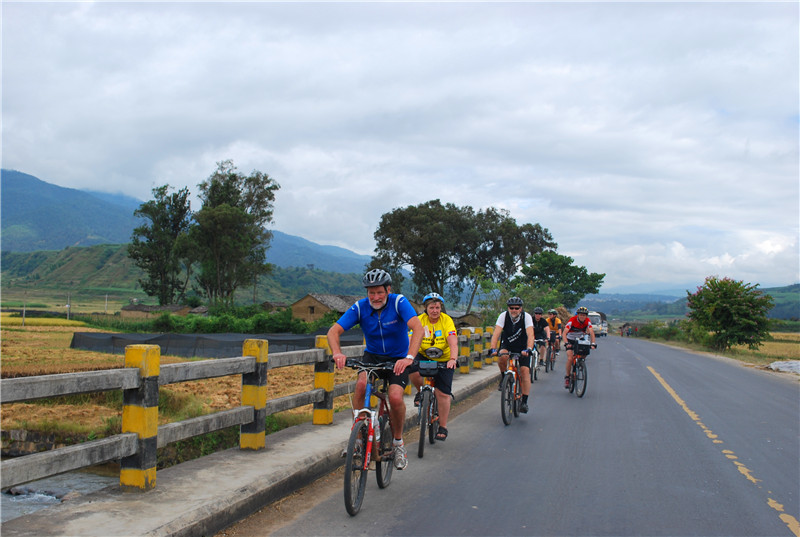
Cycling from Tiger Leaping Gorge to Shangri-La is considerably more demanding than traveling by motor vehicle.
The route from Qiaotou to Shangri-La is approximately 100 kilometers, but the major challenge is not the distance alone. The road involves sustained climbing and a major increase in elevation, making it physically demanding even for experienced cyclists.
A strong cyclist may complete the route in one day, but allowing approximately 8–10 hours is more realistic for a sightseeing-oriented ride. Less experienced cyclists should consider dividing the journey into two days and staying overnight in a suitable village or town along the route.
Cycling Safety and Supplies
There are villages and small shops along the road, but services become more scattered in some mountain sections. Cyclists should carry sufficient drinking water, high-energy food, basic repair equipment and power banks.
Mobile phone coverage can also be weaker in some remote sections.
G214 carries considerable truck traffic, and blind corners can be dangerous for cyclists. Riders should keep well to the appropriate side of the road, remain highly visible and avoid riding too close to large vehicles.
The temperature can also change quickly as the elevation increases. Even in summer, cyclists should carry a windproof and warm outer layer.
Because of the long climbs, heavy traffic and altitude gain, this route is not recommended for inexperienced cyclists.
Tiger Leaping Gorge and Shangri-La Elevation Change
One of the most important factors when traveling from Tiger Leaping Gorge to Shangri-La is the rapid change in elevation.
The lower areas around Tiger Leaping Gorge are much warmer, while Shangri-La lies at approximately 3,300 meters above sea level. Travelers may therefore experience cooler temperatures, stronger winds and symptoms related to altitude after arrival.
Avoid strenuous exercise immediately after reaching Shangri-La. Allow your body time to adjust, drink enough water and keep the first part of your stay relatively relaxed.
Best Time to Travel from Tiger Leaping Gorge to Shangri-La
The road can be traveled throughout much of the year, but weather conditions are especially important during the rainy season.
From June to September, heavy rainfall can increase the possibility of falling rocks, landslides and temporary road disruptions along mountain sections of G214. Travelers should check current road conditions before departure.
Morning and evening temperatures in Shangri-La can also be considerably lower than in Tiger Leaping Gorge. Even during summer, travelers should carry a warm jacket.
Important Transportation Tips
The most important point is to confirm your exact departure location before booking transportation. Qiaotou and Middle Tiger Leaping Gorge are not the same place. A traveler staying at Tina's Guesthouse should not assume that a bus departing from Qiaotou will pick them up directly.
For independent travelers, the regular bus from Qiaotou is generally the simplest road transportation option. For hikers finishing the Tiger Leaping Gorge high trail, the afternoon tourist shuttle from Tina's Guesthouse is particularly convenient. Private cars are the best choice for travelers who want flexibility, while motorcycles and bicycles are suitable only for riders with appropriate road and high-altitude experience.
Travelers should also keep some flexibility in their schedules during the rainy season because mountain road conditions can change quickly.
Tiger Leaping Gorge to Shangri-La Route at a Glance
Tiger Leaping Gorge – Qiaotou – G214 – Shangri-La
For travelers beginning at Middle Tiger Leaping Gorge:
Middle Tiger Leaping Gorge – Mountain Roads – Qiaotou – G214 – Shangri-La
The road gradually leaves the deep Jinsha River valley and climbs toward the highland landscape around Shangri-La, with increasingly cooler temperatures, mountain scenery and open plateau views along the way.
For travelers planning a larger Yunnan itinerary, this route can be combined with Lijiang, Shangri-La, Meili Snow Mountain, Yunnan–Tibet routes and other destinations in northwestern Yunnan.