Junsai Wa, Lahu, Lisu, and De'ang Ethnic Township (军赛佤族拉祜族傈僳族德昂族乡) is a township under the jurisdiction of Zhenkang County (镇康县), Lincang City (临沧市), Yunnan Province (云南省). It is located in the southeastern part of Zhenkang County, bordered by Mengjian Township (勐简乡) of Gengma County (耿马县) across the Nanting River (南汀河) to the east, adjacent to Muchang Township (木场乡) to the west, and connected with Chonggang Township (崇岗乡) of Yongde County (永德县) to the north. The township covers an area of 184.21 square kilometers.
Before 1950, it was under the jurisdiction of the Gengma Tusi (耿马土司). In March 1988, it was reorganized from a district into a township, officially established as Junsai Wa, Lahu, Lisu, and De'ang Ethnic Township. As of the end of 2019, it had a registered population of 14,474. By June 2020, the township administered 6 villages, with its government located in Huatian Natural Village (花田自然村).
By 2019, the township had 14 industrial enterprises, including 2 above-scale enterprises, and 22 general stores or supermarkets with business areas over 50 square meters.
Basic Information:
Before 1950, Junsai was under the jurisdiction of the Gengma Tusi (耿马土司).
As of June 2020, Junsai Wa, Lahu, Lisu, and De'ang Ethnic Township governs 6 administrative villages:
The township government is seated in Huatian Natural Village (花田自然村).
The township lies in the southeastern part of Zhenkang County, bordered by Mengjian Township (勐简乡) of Gengma County across the Nanting River to the east, adjacent to Muchang Township (木场乡) to the west, and connected with Chonggang Township (崇岗乡) of Yongde County to the north. It covers a total area of 184.21 km².
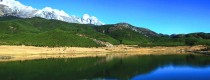
The terrain of Junsai Township is higher in the north and lower in the south, divided into basin areas and mountainous regions. The southern area along the northwest bank of the Nanting River consists of rolling hills and basins, accounting for about 44% of the total area. The northern part belongs to the branch ranges of the Xuezhulin Mountains (雪竹林山脉), featuring karst landforms and covering about 56% of the area.
The township has a typical subtropical monsoon climate characterized by distinct wet and dry seasons, abundant rainfall, and significant vertical climate variation.
The township has proven reserves of copper, tin, limestone, high-quality river sand, and clay for bricks and tiles. Aluminum, zinc, and tin are mainly found in Kanjinshan Natural Village (砍金山自然村) of Caikao Village (彩靠村). High-quality river sand is mainly distributed in Junsai Village (军赛村), Chalu Village (岔路村), and Mangjili Village (忙吉利村).
In 2011, the cultivated land area was 21,000 mu, with a significant portion devoted to agriculture.
The township is prone to natural disasters such as floods, droughts, hailstorms, pests, fires, and lightning strikes, with floods occurring most frequently.
By the end of 2011, the total population was around 13,000, including 1,090 permanent urban residents, with an urbanization rate of 8%. The township also had a floating population of 3,205.
Demographic indicators (2011):
By the end of 2019, the registered population reached 14,474.