Sigangli (司岗里) is an ancient creation myth and oral epic of the Wa ethnic group (佤族), widely circulated in Ximeng Wa Autonomous County (西盟佤族自治县) of Yunnan Province (云南省). In 2008, it was inscribed into the second batch of the National Intangible Cultural Heritage Extension List of China (Category: Folk Literature, Code Ⅰ-74).
The term originates from the Wa language: “Sigang” means “cliff cave” or “gourd,” while “li” means “to come out.” Together, Sigangli refers to the myth of humankind emerging from a sealed cave, symbolizing the Wa people’s origin story. The legend narrates how deities and animals helped early humans escape confinement, settle the land, and multiply. Today, Sigangli is regarded as the Wa people’s central narrative of origin, embodying their cosmology, history, religion, and ethics.
The Sigangli myth tells of a time when humans were trapped in a massive cave. The supreme deity Mo Wei (莫伟) sent a bird, Xiao Laique (小来雀), to peck open the rock. A mouse lured away the tiger guarding the cave, and a spider sealed the tree blocking the exit, allowing humans to finally escape into the world. They then spread across the land, built communities, and began new lives.
The legend is geographically tied to Bagadai (巴格岱), a site near Yue Song Township (岳宋乡) of Cangyuan Wa Autonomous County (沧源佤族自治县), bordering Myanmar. For generations, the Wa people gathered at Bagadai for rituals, including bull sacrifices, to honor their origin.
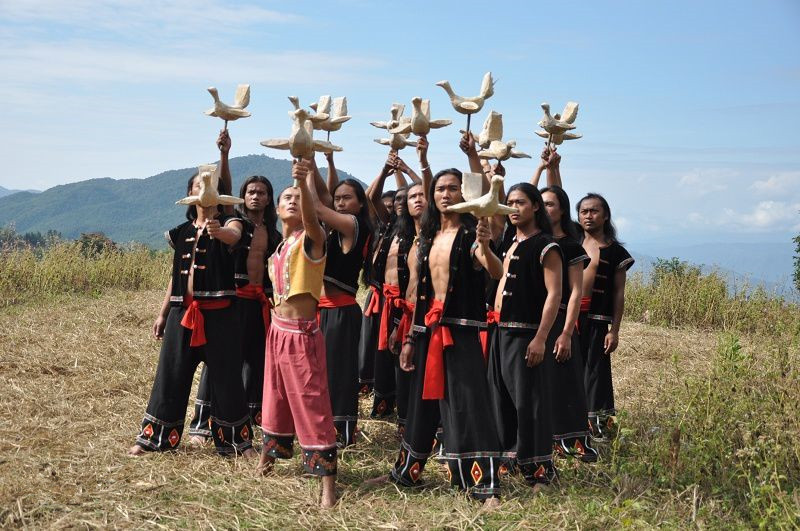
In 2011, Lincang City (临沧市) introduced a large-scale dance drama titled Sigangli, inspired by the myth. The performance consists of four chapters—Ancient Songs, Mountain Ballads, Divine Charm, and Voices of the Heart. It debuted at the Wa ethnic festival Monihei Carnival (摸你黑狂欢节) on May 1, 2011.
The stage production uses nine symbolic cultural motifs—ranging from cliff-cave sites and rock paintings to Wa architecture and folk dance—to showcase Wa philosophy: reverence for life, harmony with nature, unity, and resilience. It not only reflects three thousand years of Wa cultural heritage but also conveys universal values of creativity, cooperation, and respect for tradition.
Sigangli represents the Wa people’s collective wisdom. It is more than a creation myth—it integrates history, ethics, religion, and philosophy. As both myth and epic, it blends oral storytelling, ritual performance, and folk songs. For the Wa, Sigangli is the cornerstone of their cultural memory and identity.
Sigangli (司岗里) is not only the Wa people’s creation myth but also a living embodiment of their worldview, history, and cultural resilience. Rooted in oral tradition, it has endured for centuries, evolving from myth to epic to modern stage performance. Its preservation highlights the Wa people’s reverence for origins, nature, and community values.