7 Days GolfingTour
 8 Days Group Tour
 8 Days Yunnan Tour
 7 Days Shangri La Hiking
 11 Days Yunnan Tour
 6 Days Yuanyang Terraces
 11 Days Yunnan Tour
 8 Days South Yunnan
 7 Days Tea Tour
 8 Days Muslim Tour
 12 Days Self-Driving
 4 Days Haba Climbing
 Tiger Leaping Gorge
 Stone Forest
 Yunnan-Tibet
 Hani Rice Terraces
 Kunming
 Lijiang
 Shangri-la
 Dali
Dali
 XishuangBanna
 Honghe
 Kunming
 Lijiang
 Shangri-la
 Yuanyang Rice Terraces
 Nujiang
 XishuangBanna
 Spring City Golf
 Snow Mountain Golf
 Stone Mountain Golf







20 Days West Yunnan and Three Parallel Rivers Overland Tour
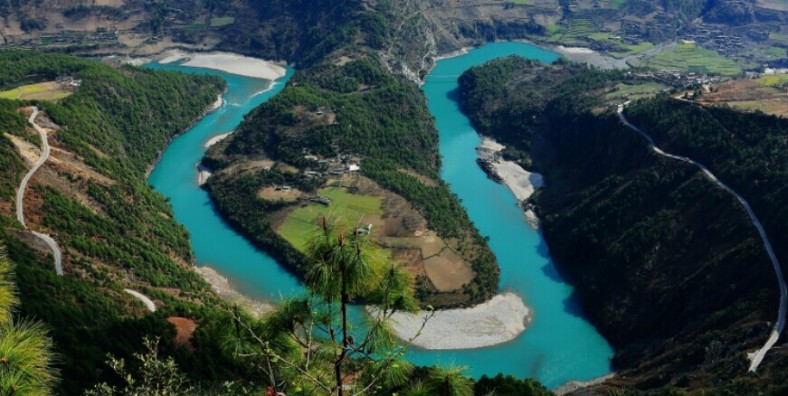
Tour Overview
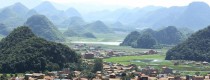
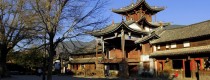
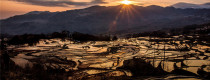
This 20 Days Yunnan ethnic minority tour focuses on most famous cities and classic attractions in Yunnan Province and you will meet many ethnic groups to experience their culture...
Length of Travel: 19 Day
Destinations of Tour: Mangshi-Ruili-Longchuan-Yingjiang-Lianghe-Tengchong-Lushui-Fugong-Gongshan-Bngzhongluo-Cizhong-Feilaisi-Deqin-Benzilan-Shangrila-Baishuitai-Tiger Leaping Gorge-Shigu-Lijiang-Baisha-Shaxi-Dali-Xiangyun-Chuxiong-Kunming
Departure City: Kunming
Price of Tour: Request
Type of Tour:
Features of Tour: Ethnic culture tours Historical and cultural tours Nature scenery
This 20 Days Yunnan ethnic minority tour focuses on most famous cities and classic attractions in Yunnan Province and you will meet many ethnic groups to experience their culture and life during the tour.
Highlights
- Appreciate the fabulous Yunnan natural scenery.
- Meet colorful ethnic villages and tribal groups to appreciate the diverse ethnic cultures.
- Visit anacient towns, historical heritage and ancient villages to discover the mysterious history of Yunnan.
Brief Itinerary
- Day 1 Arrive in Mangshi City
- Day 2 Mangshi-Ruili
- Day 3 Ruili-Longchuan-Yingjiang-Lianghe-Tengchong
- Day 4 Tengchong
- Day 5 Tengchong-Liuku
- Day 6 Liuku-Gongshan
- Day 7 Gongshan-Binglzhongluo
- Day 8 Bingzhongluo
- Day 9 Bingzhongluo-Biluo Snow Mountain-Cizhong
- Day 10 Cizhong-Yanmen-Meili Snow Mountain-Feilaisi
- Day 11 Feilaisi-Shangri-La
- Day 12 Shangri-La
- Day 13 Shangri-La – Baishuitai – Tiger Leaping Gorge
- Day 14Tiger Leaping Gorge-Shigu Town-Lijiang
- Day 15 Lijiang
- Day 16 Lijiang – Shaxi-Dali
- Day 17 Dali
- Day 18 Dali-Yunnanyi-Chuxiong-Kunming
- Day 19 Kunming
- Day 20 Departure from Kunming
Google Map
Day 1 Mangshi Arrival
Sightseeing and Activities:Mangshi arrival
Accommodation:Mangshi
Meals:none
Take a flight to Mangshi. Meet your guide and driver. Then transfer to hotel.
Day 2 Mangshi-Ruili
Sightseeing and Activities:Wangdin, One Single Tree Forest, night market
Accommodation:Ruili
Meals:B,L
Drive from Mangshi to Ruili, on the way, visit Wangdin, a border town with Burma, and the One Single Tree Forest. Upon arriving Ruili, check in the Hotel. After dinner, visit the well-known night market.
Day 3 Ruili–Longchuan-Yinjiang-Lianghe-Tengchong
Sightseeing and Activities:minority villages and local markets, Jingpo Ethnic Village, Jingpo Square, Dayinjiang River, Tongbiguan Pass, Nandian Xuanwu Chieftain Office
Accommodation:Tengchong
Meals:B,L
Visit minority villages and local markets around Ruili. Arrive in Longchuan County, visit Jingpo Ethnic Village and Jingpo Square. Then drive to Yinjiang County. Visit Dayinjiang River and Tongbiguan Pass, a famous local scenic spot.
Drive to Lianghe County and visit the Nandian Xuanwu Chieftain Office, the ancient houses of the Chieftains in the past. Drive to Tengchong in the late afternoon.
Day 4 Tengchong
Sightseeing and Activities:Heshun Ancient Town, Beihai Lake Park
Accommodation:Tengchong
Meals:B,L
Visit Heshun Ancient Town including the Museum of Yunnan-Burmese Anti-Japanese War, Heshun Library, the Archway, Dragon Pool, the Wanlouzi Museum of Native Residence, Wenchang Daoist Palace, Clothes-washing Pavilions, Yuanlong Daoist Pavilion, the Philosopher Ai Siqi’s Former Residence, Guanyin Ancient Spruce Trees an so on.
Visit the Beihai Lake Park and cruise to the lake.
Day 5 Tengchong-Liuku
Sightseeing and Activities: The Cluster of Volcanoes, Nujiang River
Accommodation:Liuku
Meals:B,L
In the morning, visit Tengchong Cluster of Volcanoes. It is located in Tengchong and Lianghe County in the southwest of Yunnan Province. It is one of the four major volcanoes in China and has 97 volcanoes. The entire volcanic group covers an area of 221.36 square kilometers. The special geological structure has formed the unique volcanic landform, covering volcanic cones, volcanic caves, lava fields, volcanic lakes, dammed waterfalls etc. The volcanoes group is fantastic in terms of the large scale, diversity, integrity and good preservation. It enjoys high scientific research and ornamental value, and is known as the “Volcanic Geology Museum”.
After that, drive to Liuku for overnight. On the way, enjoy the scenery of Nujiang River and visit Nujiang River Bridge.
Day 6 Liuku-Gongshan
Sightseeing and Activities: Nujiang Grand Canyon, Flying Stones, Stone Moon
Accommodation:Gongshan
Meals:B,L
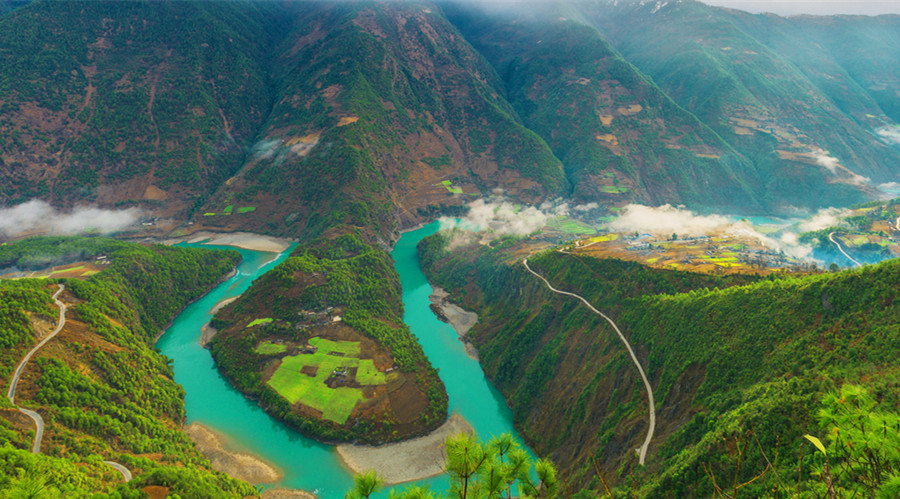
Drive from Liuku to Gongshan. On the way you can enjoy the beautiful landscapes of the Nujiang Grand Canyon with the Flying Stones and the Stone Moon.
The 247-kilometer-long Nujiang River Gorge is flanked by two 4,000-meter-high mountains. The mountain peaks on the two sides have an average altitude of over 3,000 kilometers. The gorge is located in Yunnan Province in southwestern China, an area rich in ethnic minority culture. It is now a first choice for many domestic and foreign travelers.
Day 7 Gongshan-Bingzhongluo
Sightseeing and Activities: First Bend of Nujiang River(Salween River), the stone house of the Nu Nationality, Peach Island, the Tibetan Puhua Temple
Accommodation:Bingluozhong
Meals:B,L
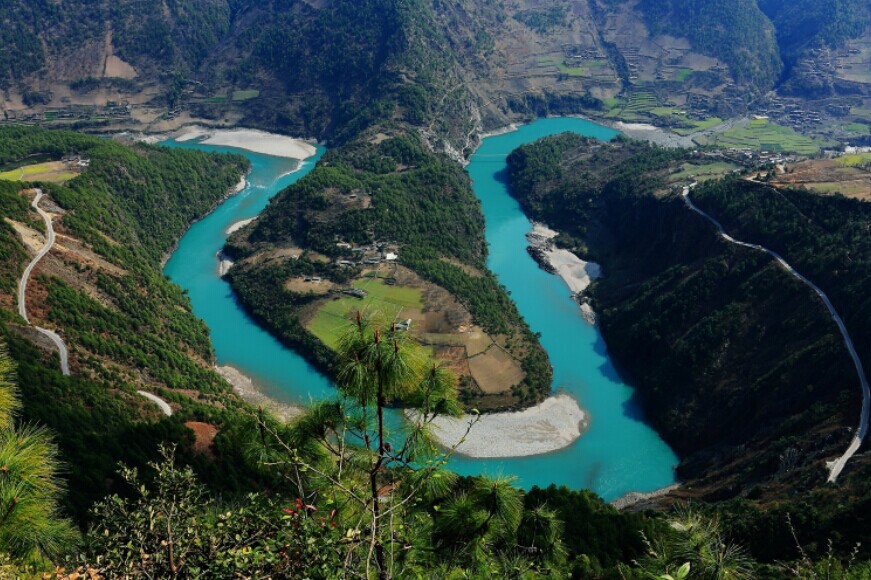
One full day excursion to Bingzhongluo, sightseeing includes the First Bend of Nujiang River(Salween River), the stone house of the Nu Nationality, Peach Island, the Tibetan Puhua Temple. You will then have the chance to visit a minority household and experience the life of the local people.
Day 8 Bingzhongluo
Sightseeing and Activities: Ethnic village, Tea-Horse Caravan Route, Zhongding Catholic Church
Accommodation:Bingluozhong
Meals:B,L
There are easy and beautiful walks to nearby villages along the Nujiang. A few kilometers outside of town, the river widens and cuts through very deep and dramatic gorges. The road hugs the Nujiang and landslides occur from time to time along the way. It is said that the scenery is especially spectacular after rain, however this also increases potential delays and exacerbates the danger from landslides.
The most beautiful part of Nujiang Gorge starts from Binzhongluo, the northernmost town of the Gorge, where the essential attractions of the Nujiang Gorge are located. Hiking is the best way to enjoy the landscape and an average of 2.5 hours is needed for most tourists to reach the famous “Tea Horse Caravan Route.” Renting a mini bus at Bingzhongluo town is an alternative for the less adventurous sightseers.
On the way to the “Tea-Horse Caravan Route”, you can see the 100-year-old Zhongding Catholic Church built and founded by a French missionary. Shimen Pass is another fantastic section of the gorge along with Wengli (also called Wuli), another stunning landscape lying on a beautiful slope along the river bank. Very near to the Wengli, a carved path is seen on the other bank cliff, so-called “Tea-Horse Caravan Route”, a path used by traders ferrying their goods between Yunnan and Tibet. At the end of the trekking road, an old hanging bridge and a new bridge swing side-by-side.
Day 9 Bingzhongluo-Biluo Snow Mountain-Cizhong
Sightseeing and Activities: Biluo Snow Mountain, Cizhong Church
Accommodation:Cizhong
Meals:B,L
Drive from Bingzhongluo to Cizhong. You will drive along Degong Road and pass through Biluo Snow Mountain and enjoy the mountain scenery.
After arrived at Cizhong, visit the Tibetan Catholic Church built by French missionaries in 1867, the church is used by Tibetan, Naxi and Lisu people. They still have the grapes planted by missionaries and old the traditional way of making wine.
Day 10 Cizhong-Meili Snow Mountain-Feilaisi
Sightseeing and Activities: Feilaisi, Meili Snow Mountain, Mingyong Glacier
Accommodation: Feilaisi
Meals: Breakfast, Lunch
Drive along Lancang River to Mingyong Village. Visit Mingyong Glacier (2600m) which is the low altitude glacier of the lowest latitude in the world.
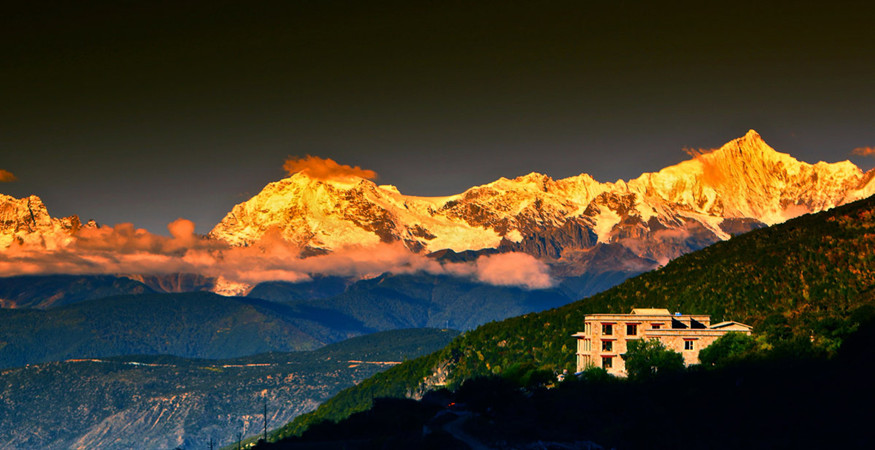
Arrive at Feilaisi in the late afternoon, you will have a nice sunset view of Meili Snow Mountain from the Sightseeing Platform, where you can see the 13 white pagodas meaning of the 13 peaks of Meili Snow Mountain over 6,000 meters (19,685 feet) above sea level, known as the “Prince’s 13 peaks”.
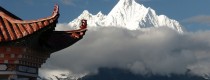
–Meili Snow Mountain (Meili Xueshan), also called Kawakarpo, is a UNESCO nature site located in Deqin County dividing Yunnan from Tibet, a wonderful place to hike and explore both nature and Tibetan culture.Rising between the Salween River and the Mekong River in the extreme edge of Northwest Yunnan, the Meili Snow Mt. region is part of Three Parallel Rivers of Yunnan Protected Areas. Legend says that the Meili Snow Mountain is a god guarding Tibetan Buddhism. With 13 peaks over 6000m in the range, the main peak Kawakarpo (“Kawagebo” in Chinese) is a sharp snow mountain with an altitude of 6740m,which has never been conquered yet.
–Lancang River is the longest river flowing from north to south in China. It takes its source from the Zhaqu of the Guangguori Peak of Tanggula Mountain Range in Qinghai Province, China. It is called the Lancang River after it reaches Changdu. The river runs south until it leaves China at the Nanla Bay out of Yunnan Province and therefrom changes its name from the Lancang River to the Mekong River. The Grand Canyon of the Lancang River is famous for not only its deep and long vale, but also the rushing water. The river water is limpid and rushing in winter, but turbid and onrushing in summer. As the river becoming narrow in the Grand Canyon, high waves are striking against the banks and making a sound like thunder. What a fantastic spectacle! Such steep mountains, deep valley and miraculous geographic structure are seldom seen all over the world.
Day 11 Feilaisi-Shangrila
Sightseeing and Activities: Benzilan, Baimang Snow Mountain Nature Reserve, the First Bend of Jinsha River or Moon Bend
Accommodation: Shangrila
Meals: Breakfast, Lunch
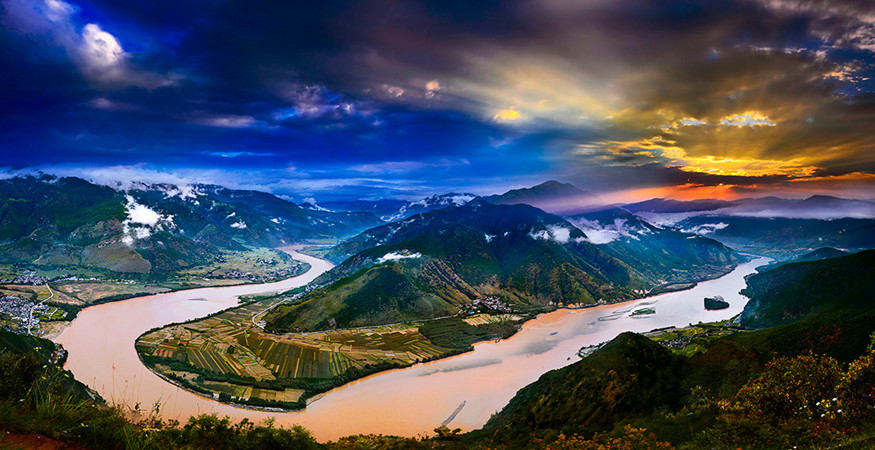
In the morning, drive back to Shangri-la. You will stop at Benzilan for lunch. Visit Baimang Snow Mountain Nature Reserve, you will be able to view Baimang Snow Mountain if the weather is clear, pass the top part of today at 4292m altitude at 156km. After that, visit the First Bend of Jinsha River or Moon Bend, which is the boundary between Sichuan and Yunnan. This is different from the First Bend of Yangtze River in Lijiang City. The bend in Shigu Town changes the flow direction of the Yangtze River but in Benzilan, the Moon Bend is just a grand bend between the mountains with an impressive scenery.
Day 12 Shangrila
Sightseeing and Activities: Songzanlin Monastery, Pudacuo National Park, Shudu Lake, Tibet Family
Accommodation: Shangrila
Meals: Breakfast, Lunch
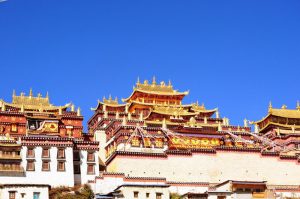
In the morning, visit the Ganden Sumtseling Monastery, the largest Tibetan monastery in Yunnan. Songzanlin Monastery has another alias ‘the little Potala Palace ‘, so named because the whole monastery is in the traditional style with mysterious atmosphere. Walk around Songzanlin Monastery.
At noon, you will visit a Tibetan’s family to experience the local life and you will try Tibetan home-made yak and cheese.
And afterwards you’ll visit the tranquil Shudu Lake in Pudacuo National Park. Pudacuo National Park is located in one of the most biologically-diverse regions of the world. While the region comprises only 0.7 percent of China’s land area, it contains more than 20 percent of the country’s plant species, about one-third of its mammal and bird species and almost 100 endangered species.
Day 13 Shangrila-Baishuitai-Tiger Leaping Gorge
Sightseeing and Activities: Baishuitai, Tiger Leaping Gorge
Accommodation: Tiger Leaping Gorge
Meals: Breakfast, Lunch
In the morning, drive to visit Baishuitai. Baishuitai or Baishui Tableland, also named the White Water Terraces, is known as one of the most attractive destinations in mysterious Shangri-La and is an ancient Chinese landform with a history of 200,000 to 300,000 years. The main attraction in the area is a large, white mineral deposit in the form of terraced pools, formed by calcium-rich water emanating from springs at the top of the formation. It is described as the largest feature of its type in China.
Then drive to visit the Tiger Leaping Gorge, the deepest gorge in the world. With 34 rapids of the Yangtze River, it is called the Jinsha in this area because you can find gold in the river.
Day 14 Tiger Leaping Gorge-Shigu-Lijiang
Sightseeing and Activities: Shigu, Lijiang Ancient Town, Mufu Palace, Sifang Street Square
Accommodation: Lijiang
Meals: Breakfast, Lunch
In the morning, drive to the First Bend on the Yangtze River with imposing gorge scenery, visit the Iron Chain Bridge, the Red Army’s Long March Memorial Monument in the Shigu town. The town of Stone Drum got its name from a large, cylindrical, marble tablet shaped like a drum. The scenery is magnificent as the road running through the Lijiang valley which is filled with wheat fields and drying haystacks.
In the afternoon, drive to Lijiang. You’ll start a memorable tour from Lijiang Ancient Town (Dayan Ancient Town). Pay a visit to Ming-dynasty style Mufu Palace, the “Forbidden City” of Lijiang to know Tusi’s ruling history and appreciate Naxi people’s brilliant culture and fine arts. Then, wander through the old alleys, old bridges, featured shops and bars to Sifang Street Square, a mingling ground to enjoy lively atmosphere and unwind yourself.
Day 15 Lijiang
Sightseeing and Activities: Jade Dragon Snow Mountain, Lijiang Ancient Town, Ganhaizi Meadow, Baishuihe River, Impression Lijang Ethnic Show, Baisha Village, Baisha Mural
Accommodation: Lijiang
Meals: Breakfast, Lunch
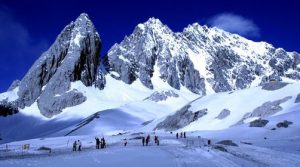
Enjoy the sunrise of the Jade Dragon Snow Mountain and Lijiang Ancient Town in the morning, drive about 30KM to Ganhaizi Meadow(3100M), you will take the sightseeig bus for a short visiting through the Baishuihe River, take the chairlift up to visit Jade Dragon Snow Mountain. The cableway will be arranged according to the condition of the mountain. You will hike around1 hours in the original forest in Spruce Meadow (3200M).
After lunch, you will enjoy the Impression Lijang Ethnic Show directed in Ganhaizi Meadow(3100M). A cultural show demonstrating the traditions and lifestyles of the Naxi, Yi and Bai peoples of the area. The show takes place inside Jade Dragon Snow Mountain Park at 3500m in an outdoor theater specifically designed to showcase the mountain which is used as a backdrop. The production itself was designed by Zhang Yimou, Fan Yue and Wang Chaoge, a cast of over 500 people, and a number of horses. In the afternoon, you’ll stroll through Baisha Village, which is an enchanting traditional Yunnan village. Visit the Baisha Mural about 600 years old, which is one part of the World Cultural Heritage by the UNESCO 1997.
Day 16 Lijiang-Shaxi-Dali
Sightseeing and Activities: Shibaoshan Mountain, Shizhong (Stone Bell) Hills, Shaxi Old Town, Dali Old Town, Foreigner Street, Erhai Lake
Accommodation: Dali
Meals: Breakfast, Lunch
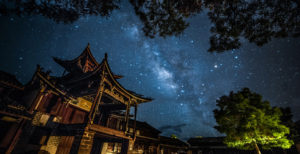
Morning , pick up from your hotel in Lijiang , drive to visit Shibaoshan Mountain. Located 25 km southwest of Jianchuan County, the Shibao (Stone Treasure) Hills are also called the Shizhong (Stone Bell) Hills. Built during the Tang and Song Dynasties, it is considered an official historical site.
Later go ahead to visit Shaxi Old Town The remains of an ancient market town and once an active trade stop on the Southern Silk Road that connected Tibet and China with Southeast Asia and on to Europe. This Road is actually older than the more famous Silk Road (in the North), predating it by at least 300 years. Shaxi has been listed by the World Monuments Fund as one of the world’s 100 most endangered sites.
After the tour , drive to Dali. Visit Dali Old Town. Walk around the Foreigner Street and enjoy the relax time with local people. After climbing up to the City Wall of Dali, you will have panoramic view of the Erhai Lake.
Day 17 Dali
Sightseeing and Activities: Three Pagodas in Chongshen Monastery,cruise in Erhai Lake, Xizhou Town, Xizhou Town,
Accommodation: Dali
Meals: Breakfast, Lunch
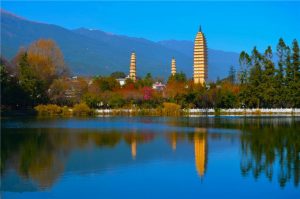
Visit the Three Pagodas in Chongshen Monastery which has a history of over 1,800 years located at the foot of Cangshan Mountain facing to the Erhai Lake. Three Pagodas are made of three ancient independent pagodas forming a symmetrical triangle.
After lunch, you’ll cruise in Erhai Lake by the small boat to the Jinsuo Islet in the east Erhai Lake. There are 200 Bai ethnic families around 1000 people in Jinsuo Island.In Erhai Lake cruise, you will enjoy the green Cangshan Mountain and the Three Pagodas from a far as well as lots of birds and seagulls flying over the lake.
After landing, you will head for Xizhou Town to fully appreciate Bai-style traditional architectural courtyards, taste their fragrant Three-Course Tea and explore their distinctive culture.
Day 18 Dali-Yunnanyi-Chuxiong-Kunming
Sightseeing and Activities: Yunnanyi Old Town, Yiren Old Town
Accommodation: Kunming
Meals: Breakfast, Lunch
Drive from Dali to Yunnanyi. Yunnanyi is located in Xiangyun County of Dali Prefecture, about four hours’ drive from Kunming. As the earliest place named Yunnan(the place to the south of the colorful cloud), Yunnanyi is the former site of Yunnan County of West Han Dynasty and Yunnan Prefecture of Wei and Jin Dynasties; in the Yuan, Ming and Qing Dynasties, Yizhan (remount or post stations) were set here, so it is named Yunnan Yi. Due to its significant geographic location, Yunnan Yi used to be a must-take position since it can connect Dali, Chengdu, Kunming, South and West Yunnan; a time-honored ancient passage stretches through the small village with well conserved folk residences of Bai.
After lunch, drive to Yi Ren Old Town in Chuxiong City. The Yi Ren old town located at the west of Chuxiong economic development zone, Yunnan. And it is fuses both China and Yi minority national traditional culture as the main key of the antique construction. With fully Yi national minority’s characteristic the entire old town selects material from Yi national minority’s modeling, totem and the color.
In the afternoon, drive to Kunming for overnight.
Day 19 Kunming
Sightseeing and Activities: Stone Forest, Birds and Flowers Market, Green Lake
Accommodation:Kunming
Meals: B, L
Drive about 85km to the Stone Forest. An old local saying says that ‘If you have visited Kunming without seeing the Stone Forest, you have wasted your time.’ Truly, the Stone Forest is one of the most important attractions of Yunnan.
In the afternoon, drive back to Kunming to visit Birds and Flowers Market. After that, stroll around the Green Lake, and enjoy local dancing and music.
Day 20 Departure from Kunming
Sightseeing and Activities: Depart from Kunming
Accommodation:none
Meals: Breakfast
Depart from Kunming. Service ends.
Service Included:
- Admission fees for all of the sightseeing spots listed in the itinerary;
- Meals as listed in the itinerary;
- Hotels as listed in the itinerary;
- Private English-speaking tour guide;
- Private vehicle for transfers & sightseeing with skilled driver;
- Service charge & government taxes;
- Luggage transfers between airports and hotels;.
Service Excluded:
- Any arrival and departure international airfares or train tickets;
- Chinese visa fees;
- Excess baggage charged by Airlines;
- Single room supplement;
- Tips to guides and drivers;
- Personal expenses and gratuities to service staff;
- Personal travel accident insurance;
- All optional programs.