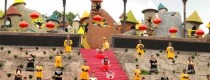
Pingcun Yi and Dai Ethnic Town in Linxiang District, Lincang City

Pingcun Yi and Dai Ethnic Town in Linxiang District, Lincang City

Pingcun Yi and Dai Township (平村彝族傣族乡) is under the jurisdiction of Linxiang District (临翔区), Lincang City (临沧市), Yunnan Province (云南省). It is located in the southeastern part of Linxiang District, east of the Lancang River (澜沧江). To the southeast and northeast, it borders Jinggu County (景谷县); to the west, across the river, it neighbors Quannei Township (圈内乡), Boshan Town (博尚镇), Matai Township (马台乡), and Bangdong Township (邦东乡); and to the north, it connects with Zhenyuan County (镇沅县). The township covers a total area of 285.14 square kilometers. As of the end of 2019, Pingcun Yi and Dai Township had a registered population of 9,160.

History

  • In 1940 (the 29th year of the Republic of China), Pingcun Township (平村乡) was established.
  • In 1950, Pingcun Township and Nayü Township (那玉乡) were set up.
  • In April 1951, Shisanbao was abolished, and Nayü, Huanliang (换良), Pingcun, and Yongping (永平) were formed as small townships under Matai Fifth District.
  • In 1958, Tuanjie Commune (团结公社) was established.
  • In 1959, it was renamed Pingcun Commune (平村公社).
  • In 1961, it was reorganized as a district.
  • In 1966, the district was changed back into a commune.
  • In 1983, the commune was changed into a district.
  • In 1987, Pingcun Yi and Dai Township (平村彝族傣族乡) was formally established.

Administrative Divisions

By the end of 2011, Pingcun Yi and Dai Township governed five village committees: Pingcun (平村), Yongping (永平), Huanliang (换良), Mangya (忙丫), and Nayü (那玉), with 63 village groups under them.
As of October 2021, the township administers five administrative villages, with the township government seated in Yakoutian Street (丫口田街), Pingcun Village (平村村).

List of Villages

  • Pingcun Village (平村村)
  • Mangya Village (忙丫村)
  • Yongping Village (永平村)
  • Huanliang Village (换良村)
  • Nayü Village (那玉村)

Geography and Environment

Location and Area

The township lies in the southeastern part of Linxiang District, east of the Lancang River, covering 285.14 square kilometers. It stretches 21.6 km from east to west and 26.4 km from north to south.

Topography

Pingcun Yi and Dai Township is situated on the southern extension of the Nujiang Mountains (怒江山脉), within the longitudinal valley region of the Hengduan Mountains (横断山脉). It lies on the watershed between the Nujiang River (怒江) and the Lancang River (澜沧江). The terrain is higher in the east and north, and lower in the west and south. The highest point is Nayü Dajianshan (那玉大尖山) at 2,122 meters above sea level, while the lowest point is Nazhao Ferry (那招渡口) at 750 meters.

Climate

The township has a subtropical climate with significant altitude differences and complex topography, creating a notable vertical climate.

  • Average annual temperature: 19℃
  • January average: 14.2℃; extreme low: 2.6℃ (2008)
  • August average: 23℃; extreme high: 34℃ (2009)
  • Annual temperature range: 21.4℃
  • No frost year-round
  • Average annual sunshine: 2,300 hours
  • Average annual rainfall: 1,333.8 mm, concentrated in July–September (August being the peak month).

Hydrology

The largest river is the Pingcun River (平村河), flowing 21.4 km from Yakoutian in Pingcun to the Lancang River, passing Yongping, Pingcun, and Huanliang. Its average annual flow is 1.6 cubic meters per second.

Population

By the end of 2011, the total population was about 9,100, with an urban resident population of 860 (urbanization rate: 9.3%) and a floating population of 234.

  • Male population: 53.1%
  • Female population: 46.8%
  • Children under 14: 18.3%
  • Working-age (15–64): 72.7%
  • Seniors (65+): 9%

Ethnic composition:

  • Han (汉族): about 43%
  • Ethnic minorities (Yi, Dai, Lahu, etc.): 57%

By the end of 2019, the registered population remained at 9,160.

Travel Tips

  • Best Time to Visit: March to May and September to November, when the weather is mild and suitable for outdoor activities.

  • Altitude Awareness: Although not extremely high, altitude differences across the township are significant. Travelers should pace themselves when hiking.

  • Local Culture: The area is home to Yi (彝族), Dai (傣族), and Lahu (拉祜族) communities. Visitors can experience traditional festivals, dances, and local cuisine.

  • Transportation: Roads are winding and may be affected by rain in summer; ensure safe travel arrangements, especially during the rainy season.

  • Shopping and Supplies: Small supermarkets and local shops are available in Pingcun Village (平村村); prepare essentials before heading into remote areas.

Related Categories