7 Days GolfingTour
 8 Days Group Tour
 8 Days Yunnan Tour
 7 Days Shangri La Hiking
 11 Days Yunnan Tour
 6 Days Yuanyang Terraces
 11 Days Yunnan Tour
 8 Days South Yunnan
 7 Days Tea Tour
 8 Days Muslim Tour
 12 Days Self-Driving
 4 Days Haba Climbing
 Tiger Leaping Gorge
 Stone Forest
 Yunnan-Tibet
 Hani Rice Terraces
 Kunming
 Lijiang
 Shangri-la
 Dali
Dali
 XishuangBanna
 Honghe
 Kunming
 Lijiang
 Shangri-la
 Yuanyang Rice Terraces
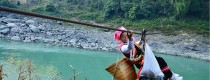 Nujiang
 XishuangBanna
 Spring City Golf
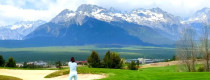 Snow Mountain Golf
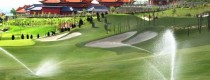 Stone Mountain Golf
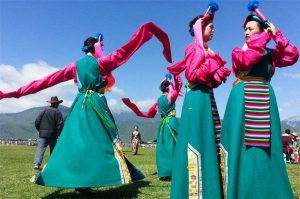
Tibetan Guozhuang Dance
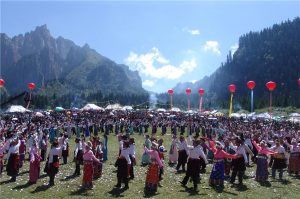
Tibetan Guozhuang Dance is one of the three major Tibetan folk dances. Guozhuang means singing and dancing in a circle, homophonic with Guoxie in Tibetan language. It originated from the form by which Tibetans danced around a campfire, all the time. This dance has been with the Tibetan ethnic group throughout their history.
Ganzhuang is a kind of collective dance of Tibetan self-entertainment and without instrument. The Tibetan area of Shangri-La County in Diqing Tibetan Autonomous Prefecture calls it a Fruit Table(果桌), and consciousness is a joyous dance.
Content
There are three kinds of Guozhuang: Temple Guozhuang, Farm Guozhuang and Pastoral Guozhuang.
- The Temple Guozhuang event is organized for religious purposes in temples or monasteries, or for greeting and sending-off the Living Buddha. It is solemn with strong religious implications, through which believers dance in honor of the Living Buddha, grateful for their expected bliss in their afterlife.
- The Farm Guozhuang consists of two parts: singing, and quick singing and dancing. The tempo is subdivided into slow, medium and quick. At the beginning of a performance men and women stand in two separate circles and sing in rotation while swaying and stamping their feet. They conclude their singing by shouting “Ya!” Then their steps quicken and come to a stop at an exuberant allegro. The allegro music is often a condensed version of the slow music. The Farm Guozhuang is popular in Qamdo in eastern Tibet, while the Pastoral Guozhuang is popular in the vast pasture land of Damxung, Heihe and Sog Xian.
- The Pastoral Guozhuang is largely the same as farm Guozhuang, but there is a big difference in movement. In pastoral Guozhuang, for instance, the dancers jump while waving their hands in front of their chests and step forward, and then turn left or right, and their hands and feet move in the same direction. The sonorous singing produces a magnificent effect.
Guozhuang Dance in Shangri-La County has a very broad mass base, and almost every town has its own team of Guozhuang Dance .
How to Dance Guozhuang
Guozhuang Dance emphasizes mainly the dancing postures and emotion expressing. Although Guozhuang Dance has various schools and categories, whose nature and dancing way are the same. If you can master one type, you can dance others after a short training.
The dancing steps of Guozhuang are agile and vigorous. On the plaza or courtyard, male dancer and female dancer get together, hand in hand, dance clockwise in a circle.When dancing, the dancers are singing the folk songs. Usually, male dancers take the lead to sing and then female dancers sing later on.
The loose, wide trousers of the male dancers look like the feathered legs of eagles, and the men’s movements are imitative of creatures, especially eagles, like an eagle spreading its wings, hopping, and soaring. Women expose their right arms during dancing, with the right sleeve waggling behind. Moving around a circle, they sway their joined hands frontward and backward, keeping beats of their steps, until very late at night.
Chinese Version:
http://www.ynich.cn/view-ml-11110-1241.html http://www.ynich.cn/view-ml-11111-1208.html