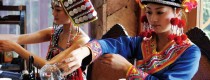
Lu Guizhi: A Guardian of Yi Ethnic Costume and Inheritor of Jingdong’s Embroidery Legacy
Basic Background and Learning Journey
Lu Guizhi (鲁桂枝), an ethnic Yi woman (彝族女性) and provincial-level intangible cultural heritage representative inheritor (省级非物质文化遗产代表性传承人) from Jingdong County, Pu’er City, Yunnan Province, is a preeminent figure in the preservation of Jingdong Yi ethnic costume craftsmanship (景东彝族服饰制作技艺). Though public records of her personal life are limited, her legacy as a master embroiderer, designer, and mentor is deeply etched into the cultural fabric of Jingdong. Recognized as a "Provincial Folk Artist" (省级民族民间美术艺人), she specializes in traditional Yi costume design, tailoring, and embroidery. As the mentor of Li Haixian—one of Jingdong’s earliest provincial inheritors—she has played a pivotal role in sustaining Yi embroidery, ensuring its continuity across generations.
Learning Journey: A Legacy of Mentorship
Lu’s connection to Yi embroidery is rooted in family and community tradition:
- Cultural Immersion: Born into a Yi community in Jingdong’s Anding Township, she absorbed the tribe’s textile heritage from childhood, surrounded by the sights of embroidered garments, vibrant threads, and the rhythmic clatter of needles.
- Mentorship Lineage: While specific details of her early training are sparse, her status as Li Haixian’s mentor highlights her role as a bridge between generations. Li, who began learning from Lu at age 10, later became a provincial inheritor and "Yunnan Cloud Ridge Master Craftsman" (云岭技能大师), underscoring Lu’s skill in transmitting Yi embroidery’s essence.
Artistic Characteristics and Technical Mastery
Lu’s artistry lies in her profound understanding of Yi embroidery’s techniques, aesthetics, and cultural symbolism:
Embroidery Techniques: Precision and Diversity
Lu excels in a wide range of traditional Yi embroidery stitches, including:
- Basic Stitches: Tiao(挑花, cross-stitch), xiu(绣花, satin stitch), bu(补花, appliqué), na(纳花, couching), and kou(扣花, buttonhole stitch).
- Advanced Techniques: Single-sided and double-sided embroidery, zaihua(栽花, raised embroidery), dazi(打籽绣, seed-stitch), and panzhen(盘针绣, coiled stitch).These methods allow her to create intricate, layered designs with exceptional durability and visual depth.
Stylistic and Color Preferences
- Color Palette: Reflecting Anding Township’s Yi traditions, Lu favors bold yet harmonious colors—primarily white, cyan, and blue—evoking the region’s natural landscapes (sky, water, and flora).
- Motifs: Her designs draw inspiration from nature (peonies, camellias, mandarin ducks, butterflies) and Yi totems, blending realism with symbolic storytelling.
Yi Costume Craftsmanship: Complexity and Utility
Lu’s work extends beyond embroidery to the full creation of Yi garments:
- 19-Piece Ensemble: A complete Yi woman’s ceremonial outfit includes a headscarf, blouse, shawl, apron, sash, trousers, and accessories—all hand-embroidered.
- Functional Artistry: Every piece, from embroidered shoes to coin purses, merges practicality with beauty, embodying Yi women’s skill in daily life and ritual.
Cultural Contributions and Legacy
Safeguarding Yi Embroidery
As a provincial inheritor, Lu has preserved Jingdong Yi embroidery—a 1,700-year-old tradition with roots in ancient Yi painting, symbolism, and clothing. Her studio, though informal, serves as a living classroom where she teaches stitching, pattern design, and garment construction, ensuring the craft’s survival.
Nurturing the Next Generation
Lu’s most enduring legacy lies in her mentorship of Li Haixian. Under Lu’s guidance, Li mastered Yi embroidery and went on to train hundreds of women, creating a robust传承梯队 (inheritance ladder). This chain—from Lu to Li, and now to Li’s students—has solidified Yi embroidery’s place in Jingdong’s cultural landscape.
Enhancing Cultural Identity
Lu’s work reinforces Yi cultural pride. Her embroidered garments, worn during festivals and weddings, are not just attire but symbols of Yi identity. As the Yi saying goes, "A mountain without trees isn’t a mountain; a Yi woman who can’t embroider isn’t a Yi woman"—Lu’s craft keeps this adage alive.
Cultural Context of Jingdong Yi Costume
Historical Roots
Jingdong’s Yi embroidery traces back over 1,700 years to the Three Kingdoms period, evolving from ancient Yi painting and symbolic notation. It reflects the tribe’s totem worship, agricultural life, and connection to nature.
Regional Significance
As one of Yunnan’s 6 Yi Autonomous Counties (and one of 8 nationally), Jingdong preserves Yi culture in its purest form. Lu’s work, centered in Anding Township, embodies this unbroken heritage.
Challenges and Preservation
Challenges
- Aging Artisans: Few young people master the craft’s complexity.
- Modern Pressures: Machine-made garments and shifting lifestyles reduce demand for handmade pieces.
Protective Efforts
- Policy Support: Lu and Li are recognized as provincial inheritors, with their work cataloged in Yunnan’s intangible heritage.
- Tourism and Innovation: Jingdong promotes "intangible heritage + tourism," showcasing Yi embroidery at festivals. Li Haixian’s studios also blend tradition with modern design, creating marketable products.
Conclusion
Lu Guizhi is more than an embroiderer—she is a guardian of Yi soul (彝族文化的精神守护者). Her hands, calloused by decades of stitching, have woven history, identity, and art into every garment. Through mentorship and unwavering dedication, she ensures Jingdong’s Yi embroidery legacy will thrive for generations.To learn more, contact the Jingdong County Culture and Tourism Bureau (景东县文化和旅游局) or explore local cultural centers to witness Yi embroidery’s beauty and Lu’s enduring impact.