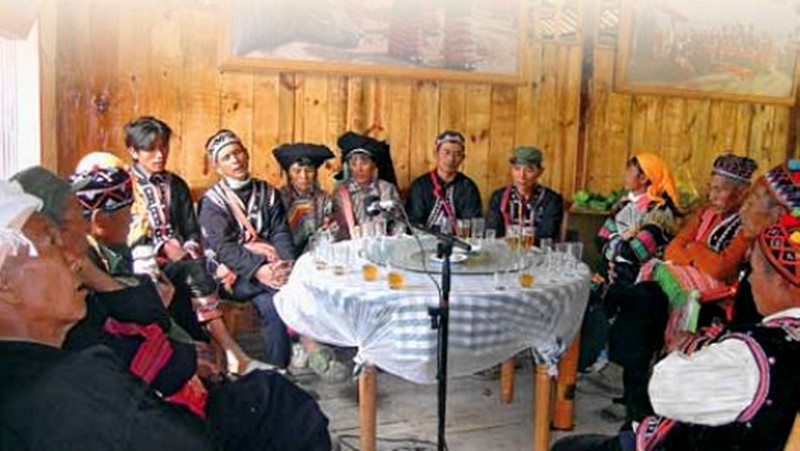
Li Zhamo (1960 – ), from Laodabao Village (老达保寨), Menggen Village (勐根村), Jiujing Hani Township (酒井哈尼族乡), Lancang Lahu Autonomous County (澜沧拉祜族自治县), Pu’er City (普洱市), Yunnan Province (云南省), is the provincial-level representative inheritor of the Lahu creation epic Mupa Mipa (牡帕密帕).
His artistic journey spans the critical transformation of this epic—from being on the brink of extinction to systematic preservation. Known as the “Guardian of the Epic in the Lahu Mountains,” Li has dedicated over six decades to keeping the tradition alive, elevating Mupa Mipa from firepit storytelling to the national stage.
Born into a family of Lahu Baha Ayi (巴哈阿依, epic singers), Li Zhamo grew up immersed in the epic tradition.
At 7 years old, he began learning systematically from his father and other folk artists.
By 12, he could perform core chapters such as The Creation of Heaven and Earth and The Creation of All Beings.
At 18, he became the youngest local singer qualified to lead major ritual festivals such as the Kuota Festival (扩塔节) and the Torch Festival (火把节).
His singing combines the grandeur of the Lahu Lada Tune (腊达调) with the agility of the Aci Tune (阿茨调), producing a unique style that is solemn, improvisational, and deeply moving.
In 1985, Li won second prize at the Yunnan Provincial Folk Song and Dance Festival, marking the start of his professional artistic career.
Authenticity of Texts: He has preserved sections of related epics such as Axi de Xianji (阿细的先基) and Meige (梅葛). His distinctive throat-singing and triple-meter rhythm have been recognized in The Collection of Chinese Folk Songs – Yunnan Volume as a standard Lahu narrative form.
Integrity of Rituals: Li strictly follows the nine-step ritual process—“Inviting the Deities – Purification – Antiphonal Singing – Sending the Deities.” His performances during the Kuzhaza Festival (苦扎扎节) authentically recreate ancient migration myths.
When fewer than 10 elders could still sing Mupa Mipa in its entirety, Li launched a cultural rescue project:
Field Research: He trekked to 15 Lahu villages in and around Lancang, collecting 12 endangered tunes (e.g., Alao Biaoni Yaolai Nega 阿老表你要来呢嘎) and recording over 60 hours of original audio.
Community Teaching: By founding “Epic Night Schools” around the firepit, he trained a new generation of performers such as Zhu Wansui (朱万岁) and Li Yunhui (李云慧). Thanks to his efforts, Laodabao now has over 100 residents capable of singing the epic.
Family Lineage: His son Li Zhage (李扎戈), the fifth-generation successor, can now independently perform major ritual songs.
Ritual Practice: By leading annual events such as the Angmatu Festival (昂玛突节), he has formed a dedicated performance troupe with 12 singers and 4 assistants.
Community Training: He founded the “Li Zhamo Epic Training Center (李扎莫史诗传习所),” where over 20 apprentices have been trained. His chief disciple Zhu Wansui now performs key pieces such as Songs of Joy.
Recognition: Selected in 2014 as a provincial-level intangible cultural heritage representative inheritor; featured in CCTV’s Homeland China.
Awards: In 2019, he led his troupe to win the “Caiyun Bronze Award” at the Yunnan Folk Arts Festival.
Digital Epic: In 2025, in collaboration with Yunnan Minzu University (云南民族大学), he helped create a digital scroll of Mupa Mipa using AR technology, attracting over 1.5 million views on the “Xuexi Qiangguo” platform.
Festivals: Every year, he organizes the Laodabao Epic Cultural Festival, combining traditional epic singing with modern cross-cultural performances.
Tourist Experiences: He designed the Epic Immersive Experience Center in Laodabao Music Town (老达保音乐小镇), where visitors can try on costumes, sing ancient verses, and rehearse short scenes—welcoming over 10,000 participants annually.
Digital Archives: Partnering with Yunnan Minzu University, he helped create 3D-scanned records of epic movements and developed a VR teaching system.
Reviving Classic Performances: He has restaged endangered pieces like The White Elephant’s Rescue and The Deer’s Gratitude, enhanced with modern lighting and stage design.
Funding: Secured government subsidies for recording equipment and training stipends.
Innovation: Initiated the “Nanting River Epic Propagation Troupe,” blending Party policies with traditional singing.
Despite his success, Li faces challenges:
Generational Gap: The average age of his disciples is 42; fewer than 3 apprentices are under 30.
Limited Market: Ritual-based performances have a narrow audience, while cultural products face low profits.
To address this, he is exploring:
Digital Innovation: VR-based epic teaching systems.
Cross-Genre Music: A fusion album Epic New Rhythms, with the single Firepit Night Talk reaching 3 million plays on Douyin.
Youth Programs: Weekend epic training at Lancang Youth Activity Center, engaging over 120 students.
Li Zhamo’s work carries profound value:
Historical Research: His preserved tunes and rituals are vital for understanding Lahu society and ancient religion in southern Yunnan.
Community Identity: His multicultural troupe—Lahu, Hani, Han—serves as a model of ethnic unity, recognized as a “Demonstration Team for Ethnic Solidarity in Yunnan.”
Educational Innovation: His teaching methods, blending tradition with modern pedagogy, have been promoted across all 16 prefectures of Yunnan.
As Li himself says: “The epic is not just a song—it is the cultural gene of the Lahu people.”
Through his dedication, Mupa Mipa has journeyed from the mountain fireside to the international stage, becoming a vivid expression of China’s diverse yet unified civilization.