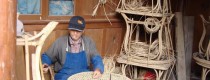
Bang Deliang (蚌德亮), Dai name Yanban (岩板), is one of Yunnan Province’s first batch of provincial-level intangible cultural heritage (ICH) representative inheritors, and a key guardian of Dai (傣族) folk art. Born in 1942 in Hudong Village (户东村), Mangdong Township (芒东乡), Lianghe County (梁河县), Dehong Prefecture (德宏州), Yunnan Province (云南省), he was exposed to art from an early age through his father, Bang Xiangbao (蚌相保), a local carving artisan.
Bang Deliang’s works combine Dai traditional culture with modern artistic elements. His creations span folk paintings, Buddhist sculptures, and Dai opera costumes, winning awards at provincial, prefectural, and county exhibitions. As a cultural inheritor, he has actively contributed to local cultural life and passed his skills to the next generation, ensuring the continuation of Dai folk art.
Name: Bang Deliang (蚌德亮), Dai name Yanban (岩板)
Gender: Male
Ethnicity: Dai (傣族)
Year of Birth: 1942
Hometown: Hudong Village, Mangdong Township, Lianghe County, Dehong Prefecture, Yunnan Province
Lianghe County lies in the western Hengduan Mountains, on the western slopes of Gaoligong Mountains, with over 20 ethnic groups, including Han, Dai, Achang, Jingpo, Deang, Lisu, and Wa.
Lianghe is known as the hometown of Chinese folk arts and Hulusi (葫芦丝), a traditional wind instrument.
Mangdong Township is a Dai-populated area; Hudong Village is one of its natural villages.
Dai motifs:
Red/Green: commemorate ancestors
Peacock: auspiciousness
Elephant: abundance and prosperity
Bang Deliang’s artistic development followed a “family tradition + formal training + creative practice” model:
| Stage | Age | Learning Content | Learning Method |
|---|---|---|---|
| Enlightenment | Childhood | Painting basics, clay modeling, wood carving | Learned from father Bang Xiangbao (local carving artisan) |
| Skill Enhancement | Youth | Farmer painting techniques | Attended folk painting workshops in early 1970s |
| Exposure Expansion | 1975 | Advanced art concepts | Participated in minority artists’ visit to Beijing organized by the Provincial Cultural Department |
| Mature Craft | 1980s | Buddhist sculpture | Sculpted statues for local temples |
| Innovation & Development | From 1998 | Dai opera costume design and performance | Designed and painted costumes; organized villagers to perform Dai opera |
Multi-disciplinary: painting, sculpture, costume design, architectural decoration
Integration: different art forms influence each other, forming a unique style
Cultural Significance: reflects Dai life, beliefs, and values; common motifs include peacock, elephant, phoenix, dragon, human figures, flowers, insects, and birds
Buddhist Influence: as followers of Theravada Buddhism, Dai folk art often incorporates Buddhist themes
Aesthetic & Practical: works combine visual appeal with functionality (e.g., Dai opera costumes and hats)
Color Usage: bright and contrasting colors (red, green, yellow, blue, black); culturally symbolic, e.g., red/green honor ancestors
Folk Paintings:
New Year prints such as “Military-Civilian Joint Defense Protecting the Homeland” and “Joyful Harvest” for Provincial People’s Publishing House
Farmer paintings exhibited at provincial, prefectural, and county levels, winning awards
Sculptures:
Buddhist statues in the 1980s for temples in Mangbang, Huyin, Jinmeng, etc.
Statues characterized by vivid forms and solemn expressions, reflecting Dai Buddhist art
Dai Opera Costume Design:
From 1998, designed and painted costumes and hats for village Dai opera performances
Costumes influenced neighboring Longchuan and Yingjiang counties; combined traditional elements with modern aesthetics
Cultural Organization:
Organized villagers to perform Dai opera, enhancing rural cultural life and promoting Dai traditional culture
Skill Transmission:
Passed skills in painting, clay modeling, and wood carving to his son Bang Youwan and siblings Bang Decheng, Bang Dezhou, ensuring multi-generational inheritance
Cultural Influence:
His costumes and paintings enriched local Dai culture and spread to neighboring regions
Dai opera organization nurtured local cultural enthusiasts and future inheritors
Innovation:
Combined traditional techniques with modern aesthetics
Costume design exemplifies innovative adaptation while preserving ethnic characteristics
Rural Cultural Revitalization:
Cultural activities invigorated rural communities, strengthened ethnic cohesion, and contributed to rural cultural and spiritual development
As a provincial-level ICH inheritor, Bang Deliang has devoted his life to preserving and innovating Dai folk art. Beginning with family inheritance, he has integrated multiple Dai art forms—painting, sculpture, and costume design—into his creative practice. His work not only has artistic and cultural value but also plays an important social role in ethnic culture promotion, education, and rural cultural revitalization. His legacy continues through the next generation, particularly his son Bang Youwan, who founded the Boma Arts School in Mangdong Township to further preserve and transmit Dai traditional culture.